

TL;DR:
- Drata's automated risk management platform continuously identifies, assesses, and tracks organizational risks, replacing manual spreadsheet processes. It uses a quantitative scoring system, mapping threats to controls, and assigns ownership to ensure accountability, all within a real-time, integrated system. AI enhances efficiency by generating threat scenarios, updating risk scores, and enabling proactive, ongoing risk mitigation.
Drata risk management is an integrated, automated platform that identifies, evaluates, and mitigates organizational risks continuously, replacing the static spreadsheets and siloed processes that still dominate most compliance programs. The platform combines risk assessments, ownership assignment, and remediation tracking into a single workflow, keeping teams audit-ready for frameworks like SOC 2, NIST CSF, and ISO 27001. For risk managers and compliance officers, this means fewer manual handoffs, real-time visibility into your risk register, and a direct line from identified threats to documented controls. If your organization is scaling its security posture and needs a structured approach to compliance risk management, Drata's model is worth understanding in depth.
How does Drata's risk assessment methodology work?
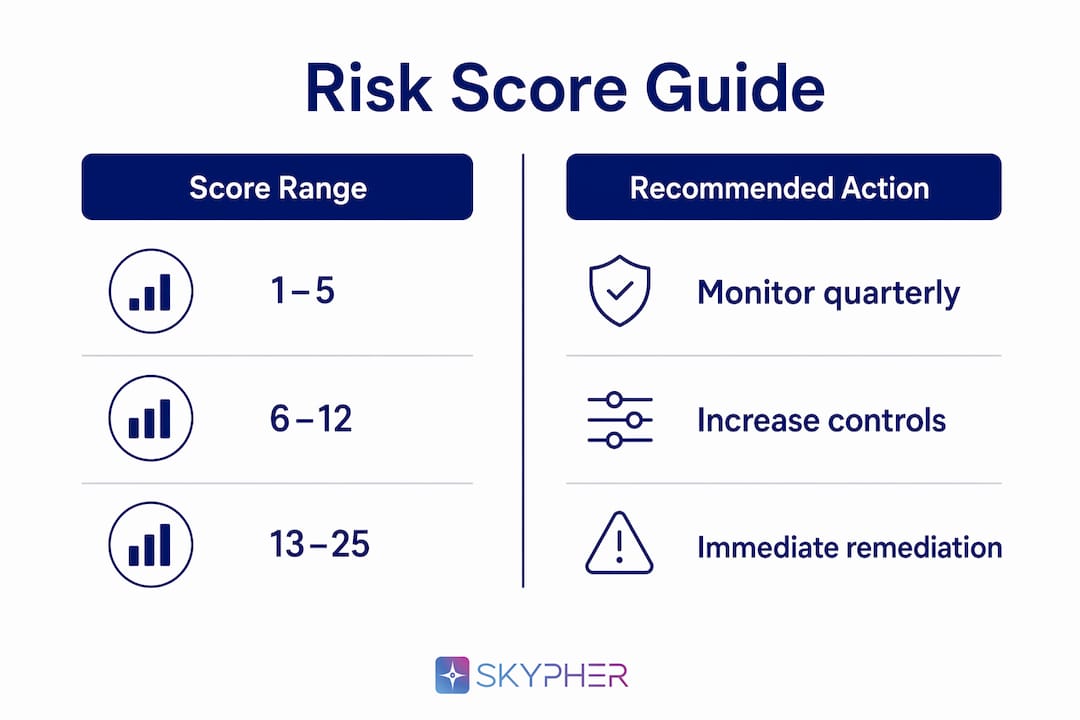
Drata's risk assessment is built on a quantitative scoring system that removes guesswork from prioritization. The platform uses a 5x5 likelihood and impact matrix to calculate an inherent risk score for each identified threat. That means every risk gets a number from 1 to 25, based on how likely it is to occur and how severe the consequences would be. The result is a risk register you can defend to auditors and executives without scrambling for supporting documentation.
The workflow starts with a short setup process. You input your organization's context, and Drata generates a risk register populated with threat scenarios drawn from recognized frameworks including NIST, OWASP, and common compliance standards. This automated register generation is the first major time savings most teams notice.
From there, the platform maps controls to each risk and flags gaps where coverage is missing. Drata also incorporates what it calls the "Lethal Trifecta" concept for AI and agentic system risk, a framework that identifies the intersection of high likelihood, high impact, and low control coverage as the most dangerous risk zone. This is particularly relevant as organizations deploy AI tools internally and need a structured way to assess the new attack surface.
Key elements of Drata's risk assessment workflow:
- Inherent risk scoring: Calculated via the 5x5 matrix before controls are applied
- Residual risk scoring: Recalculated after controls are mapped, showing actual exposure
- Threat scenario library: Pre-built scenarios aligned to NIST, OWASP, and SOC 2 requirements
- Control mapping: Each risk links directly to one or more controls in your compliance program
- Ownership assignment: Every risk gets a named owner with a defined remediation timeline
| Risk Score Range | Classification | Recommended Action |
|---|---|---|
| 1–5 | Low | Monitor quarterly |
| 6–12 | Medium | Assign owner, review monthly |
| 13–19 | High | Immediate remediation plan required |
| 20–25 | Critical | Executive escalation and urgent action |
Pro Tip: Set your residual risk threshold before you start populating the register. Teams that define acceptable risk levels upfront spend far less time debating individual scores during review cycles.
Drata vs. traditional risk management: what actually changes?
Traditional risk management relies on annual spreadsheet reviews, manual control documentation, and email chains to track remediation. Drata replaces that workflow with continuous, automated monitoring that surfaces new risks as your environment changes, not just when someone schedules a review.
The practical difference shows up most clearly in three areas: speed, accuracy, and board reporting. Manual registers go stale within weeks of completion. Drata's integrated risk management platform monitors internal and vendor risks side by side, with scoring, ownership, and remediation tracking updated in real time. That continuous visibility is what automated dashboards and reporting deliver that spreadsheets cannot.

| Capability | Traditional approach | Drata approach |
|---|---|---|
| Risk identification | Annual or ad hoc reviews | Continuous, automated monitoring |
| Documentation | Manual spreadsheets | Auto-generated risk register |
| Control mapping | Separate, often disconnected | Directly linked within platform |
| Vendor risk | Managed in separate system | Unified with internal risk register |
| Board reporting | Manual compilation | Real-time dashboards and exports |
| Audit trail | Inconsistent | Full history logged automatically |
Beyond the table, the ownership model is where Drata creates the most structural change. In traditional programs, a risk might sit in a register for months without a clear owner or a remediation deadline. Drata enforces accountability by requiring an assigned owner before a risk can be marked as accepted or mitigated. That single constraint eliminates the most common failure mode in manual programs.
Third-party risk gets the same treatment. Continuous vendor monitoring through contractual safeguards, performance reviews, and reporting mechanisms is built into the platform rather than managed through a separate tool or process. For organizations with dozens of vendors, that consolidation alone justifies the investment.
Best practices for implementing Drata risk management effectively
Successful implementation depends less on the platform and more on the decisions you make before you configure it. The organizations that get the most from Drata are the ones that treat setup as a governance exercise, not a technical one.
-
Map your compliance frameworks first. Before importing risks, identify which frameworks apply to your organization: SOC 2, NIST CSF, ISO 27001, or others. Drata aligns its control library to these frameworks, so knowing your requirements upfront prevents rework later.
-
Assign ownership at the control level, not just the risk level. Every risk needs a control, and every control needs an owner. Risks without controls provide no protection. Controls without owners never get enforced. Build this into your setup process from day one.
-
Define your risk appetite before scoring. Decide what score threshold triggers escalation to leadership. This prevents score inflation and keeps your register focused on genuine priorities.
-
Set up automated reporting dashboards for executive visibility. Compliance officers often struggle to translate risk registers into board-level language. Drata's dashboards do this automatically, but you need to configure them to reflect the metrics your leadership team actually tracks.
-
Incorporate third-party assessments from the start. Vendor risk is not a separate program. Add your critical vendors to the platform during initial setup so their risk scores appear alongside internal risks from the beginning.
-
Schedule quarterly ownership reviews, not annual ones. High-performing compliance teams integrate escalation paths and internal audits into their regular cadence. A risk that was low priority in January may be critical by April if your environment changes.
The most common pitfall is treating Drata as a documentation tool rather than a monitoring system. Teams that configure the platform and then check it once a year get spreadsheet-level results from a platform built for continuous analysis. The value compounds when you use it continuously.
Pro Tip: Run a tabletop exercise with your risk owners in the first 30 days after implementation. Walking through a simulated incident using Drata's register reveals gaps in ownership and escalation paths that no configuration checklist will catch.
How does AI improve Drata's risk management capabilities?
AI is the engine behind Drata's shift from periodic assessment to continuous risk analysis. The platform's AI capabilities generate threat scenarios, score risks, and surface control gaps without requiring a risk analyst to manually research each one. For teams managing hundreds of controls across multiple frameworks, this is the difference between a program that scales and one that breaks under its own weight.
AI-powered agents now perform structured risk assessments grounded in NIST SP 800-30 and OWASP controls, producing mapped control recommendations and approval guidance automatically. This means your team starts each assessment with a populated, framework-aligned document rather than a blank template. The time savings are significant, but the accuracy improvement matters more. Manual assessments introduce inconsistency every time a different analyst applies the scoring criteria.
Key AI-driven capabilities in modern risk management platforms like Drata:
- Automated threat scenario generation based on your industry, size, and technology stack
- Real-time risk scoring updates when your control environment changes
- Continuous monitoring alerts that flag new risks as they emerge in your environment
- AI-assisted vendor risk analysis that scores third-party security posture from questionnaire responses
- Executive summary generation that translates technical risk data into board-ready language
The role of AI in third-party risk management is particularly significant. Security questionnaire analysis, which once took days of manual review, can now be completed in minutes. That speed matters when you are onboarding a new vendor under a tight contract deadline. For a deeper look at how AI advantages in risk management translate to real operational gains, the shift from reactive to proactive risk identification is the clearest example.
Management and board engagement remains the critical factor that determines whether AI-generated insights drive action or sit unread in a dashboard. AI can surface the risk. Only leadership can authorize the resources to address it.
Key Takeaways
Drata risk management delivers the most value when automation, ownership, and continuous monitoring work together as a system rather than as separate features.
| Point | Details |
|---|---|
| Quantitative scoring drives clarity | The 5x5 matrix gives every risk a defensible score, removing subjectivity from prioritization. |
| Ownership is non-negotiable | Every risk must link to a control, and every control must have a named owner to be effective. |
| Continuous monitoring beats annual reviews | High-performing teams update escalation paths and audit risks on a rolling basis, not once a year. |
| AI accelerates assessment without replacing judgment | Automated threat scenarios and scoring save hours, but executive decisions still require human oversight. |
| Vendor risk belongs in the same register | Unified internal and third-party risk tracking gives leadership a complete picture, not two separate ones. |
Why I think most organizations underuse Drata's risk register
I have seen compliance programs at organizations ranging from 50-person startups to global financial institutions. The pattern is consistent: teams invest in a platform like Drata, configure it carefully, and then revert to treating the risk register as a compliance artifact rather than a living management tool.
The register gets updated before an audit and ignored between them. That behavior defeats the entire purpose of continuous monitoring. The organizations that actually reduce their risk exposure are the ones where the risk register is a standing agenda item in leadership meetings, not a document that gets dusted off when an auditor asks for it.
Ownership is the other underused lever. Drata makes it easy to assign a risk owner, but easy assignment does not guarantee meaningful accountability. I have seen registers where every risk is owned by the CISO because no one wanted to have the conversation about distributing responsibility. That is not risk management. That is risk theater.
The practical fix is simple. Tie risk ownership to performance reviews. When a risk owner knows their remediation progress is visible to leadership, the register becomes a tool they actively manage. Drata's dashboards make that visibility trivial to set up. The automation and smart controls are already there. The missing ingredient is almost always organizational will, not technical capability.
The compliance landscape in 2026 is moving faster than most manual programs can track. AI-generated threats, new regulatory requirements, and expanding vendor ecosystems mean your risk register from last year is already partially obsolete. Continuous monitoring is not a feature. It is the baseline requirement for any program that wants to stay credible.
— Gaspard
Complement your Drata program with Skypher's Trust Center

Drata handles your internal risk register and compliance controls. Skypher handles what happens when a prospect or partner asks you to prove it. Skypher's Trust Center Platform lets you share your security and compliance posture on demand, without routing every security questionnaire through your compliance team manually. The platform integrates with over 40 third-party risk management tools and connects directly with Slack, ServiceNow, Confluence, and Google Drive. Skypher's AI can answer up to 200 security questions in under a minute, with accuracy powered by your own documented controls. When your Drata program is producing strong compliance evidence, Skypher makes sure that evidence reaches the people asking for it, fast.
FAQ
What is Drata risk management?
Drata risk management is an integrated platform that automates risk identification, scoring, ownership assignment, and remediation tracking to keep organizations continuously audit-ready. It aligns with frameworks including SOC 2, NIST CSF, and ISO 27001.
How does Drata score risks?
Drata uses a 5x5 scoring matrix that multiplies likelihood by impact to produce an inherent risk score between 1 and 25. Residual risk is recalculated after controls are applied, showing your actual remaining exposure.
Does Drata handle third-party vendor risk?
Drata monitors internal and vendor risks within the same platform, with unified scoring, ownership, and remediation tracking. This eliminates the need for a separate third-party risk management tool for most compliance programs.
How often should you update your Drata risk register?
Effective risk management is dynamic, not static. High-performing teams review and update their risk registers on a rolling basis, with formal reviews at least quarterly and continuous monitoring alerts handling real-time changes.
What compliance frameworks does Drata support?
Drata supports a broad set of frameworks including SOC 2, ISO 27001, NIST CSF, HIPAA, and PCI DSS, with pre-built control libraries and threat scenario mappings aligned to each standard.