

HITRUST certification, formally known as the Health Information Trust Alliance Common Security Framework, is the most rigorous and widely recognized security assurance framework in the United States. Organizations that become high trust certified demonstrate their cybersecurity and privacy posture through independent third-party audits, centralized quality assurance, and a unified control library that harmonizes over 70 authoritative standards including HIPAA, ISO/IEC 27001, NIST 800-53, PCI DSS, and GDPR. The result is a credential that carries real weight in regulated industries.
The most compelling proof of HITRUST's effectiveness is this: HITRUST-certified environments maintain a 99.62% breach-free rate, far outperforming the broader industry average. That figure is not a marketing claim. It reflects what happens when prescriptive, threat-adaptive controls are combined with independent testing and a centralized review process that holds every certified organization to the same standard.
Key attributes of a high trust certified organization include:
- Validated controls across a unified, multi-regulatory framework
- Independent assessor review and HITRUST centralized quality assurance
- A certification that remains valid for two years with continuous compliance obligations
- Demonstrated risk reduction backed by measurable breach rate data
- Recognized credibility with customers, partners, and regulators in healthcare, finance, and technology
99.62% of HITRUST-certified environments remain breach-free, compared to the wider industry where third-party risk and exploits continue to surge.
What is the HITRUST Common Security Framework?
The HITRUST CSF is not simply another compliance checklist. It is a unified control library built by synthesizing the requirements of more than 70 authoritative standards and regulations into a single, coherent framework that organizations can assess against once and satisfy many regulatory obligations simultaneously.

The CSF is modular by design. Controls are assigned based on an organization's size, industry, and risk profile, which means a 50-person healthcare technology company and a 5,000-person financial services firm will each receive a tailored control set rather than a one-size-fits-all requirement list. This risk-based scoping is one of the features that separates HITRUST from frameworks that apply the same controls universally regardless of context.
Key components and harmonized standards within the HITRUST CSF include:
- HIPAA (Health Insurance Portability and Accountability Act) for healthcare data privacy and security
- ISO/IEC 27001 for information security management
- NIST 800-53 for federal and high-assurance security controls
- PCI DSS for payment card data protection
- GDPR for European data privacy requirements
- Control categories spanning access control, audit logging, incident response, risk management, and physical security
- Threat-adaptive controls that evolve with the current threat landscape rather than remaining static year over year
The CSF serves as the foundation for all three HITRUST assessment tiers: the e1, i1, and r2 assessments. Each tier draws from the same control library but applies increasing depth, scope, and rigor. Understanding the framework's structure is the prerequisite for choosing the right assessment path, which we cover next.
How do the three HITRUST assessment levels work?
HITRUST offers three degrees of assurance, and each level builds on the one below it in terms of rigor, control count, and the depth of independent validation required.
Assessment level comparison:
- e1 (Essentials): Entry-level assessment covering a focused set of foundational cybersecurity controls. Designed for organizations beginning their HITRUST journey or those with lower-risk profiles. Produces a validated report, not a full certification.
- i1 (Implemented): Intermediate assessment covering a broader control set with implementation-level testing. Appropriate for organizations that need to demonstrate a meaningful security posture to partners and customers without the full scope of r2.
- r2 (Risk-based): The highest assurance level, requiring the most extensive control set, multi-year testing, and the full HITRUST centralized quality assurance review. This is the level that produces the HITRUST CSF Certified designation and carries a two-year validity period.
The certification process, step by step:
- Define scope: Identify the systems, applications, and data flows that fall within the assessment boundary.
- Select assessment tier: Choose e1, i1, or r2 based on risk profile, customer requirements, and organizational maturity.
- Engage an approved assessor: Select a HITRUST-authorized assessor firm to lead the engagement.
- Conduct readiness assessment: Perform a gap analysis against the applicable control set to identify deficiencies before the formal audit.
- Implement and remediate controls: Address identified gaps, document evidence, and build the compliance artifacts the assessor will test.
- Third-party assessment: The approved assessor performs independent testing and validation of all in-scope controls.
- Submit to HITRUST QA: The completed assessment package is submitted to HITRUST Alliance for centralized quality assurance review.
- Receive certification: Upon passing QA, HITRUST issues the certification letter and report.
A common challenge at this stage is underestimating how long the HITRUST QA review takes. Organizations that submit incomplete evidence packages or work with assessors unfamiliar with HITRUST's documentation expectations often face extended back-and-forth that delays certification by weeks or months.

What are the real benefits of HITRUST certification for your organization?
The breach-free rate of 99.62% for HITRUST-certified environments is the clearest measure of what the framework delivers in practice. That figure reflects the combined effect of prescriptive controls, independent validation, and ongoing compliance obligations that prevent the gaps that attackers exploit.
HITRUST-certified organizations experience breach rates dramatically lower than the industry average, at a time when third-party risk and exploit-based attacks are accelerating across every sector.
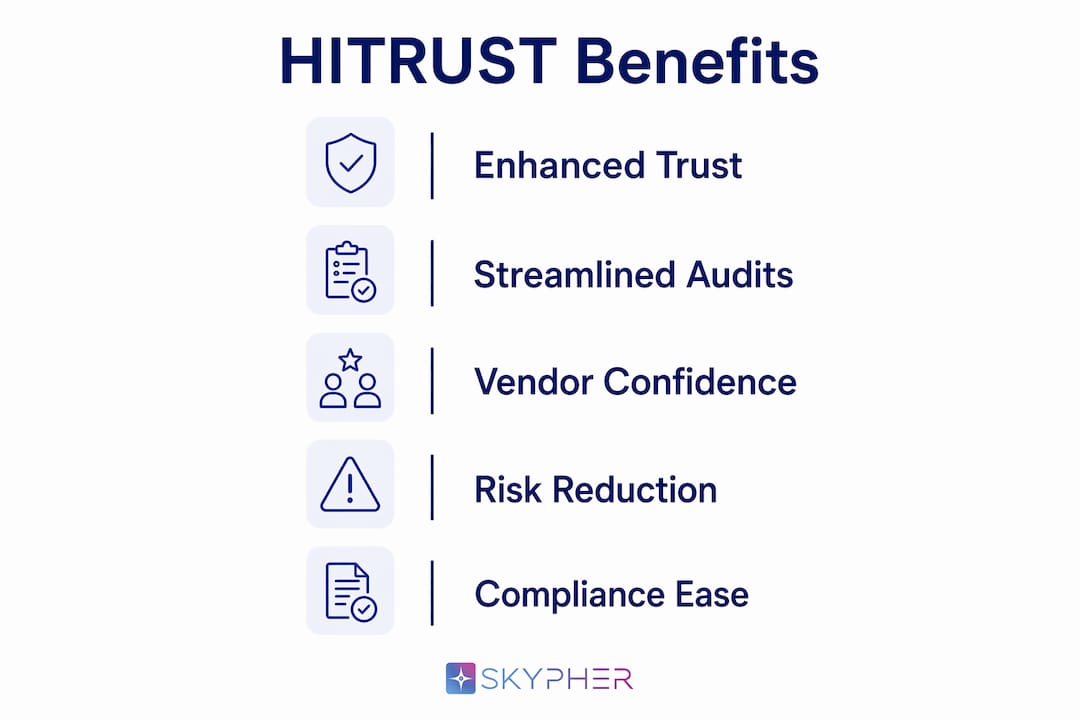
Beyond breach reduction, HITRUST certification delivers measurable organizational benefits across several dimensions:
- Multi-regulatory compliance efficiency: A single HITRUST r2 assessment can satisfy audit requirements for HIPAA, PCI DSS, NIST, and other frameworks simultaneously, reducing the cost and burden of maintaining separate compliance programs.
- Vendor and partner trust: Customers and partners increasingly require HITRUST certification as a condition of doing business, particularly in healthcare, financial services, and government contracting.
- Market differentiation: Certification signals a level of security maturity that self-attestation and questionnaire-based reviews cannot replicate.
- Contractual leverage: Many enterprise procurement teams now include HITRUST certification as a contractual requirement, making it a prerequisite for certain revenue opportunities.
- Reduced due diligence burden: A certified organization can share its HITRUST report in response to security questionnaires rather than completing each vendor assessment from scratch.
That last point connects directly to how organizations manage their third-party security reviews and vendor trust programs. HITRUST certification does not eliminate the need for security questionnaire responses, but it dramatically strengthens the answers and reduces the time required to provide them.
How to obtain and maintain HITRUST certification
Preparation is where most HITRUST programs succeed or fail. Organizations that treat the process as a documentation sprint rather than a genuine control implementation effort consistently struggle during the independent assessment phase.
Preparation steps:
- Conduct an internal readiness assessment against the target control set before engaging an external assessor
- Map existing controls to HITRUST CSF requirements to identify true gaps versus documentation gaps
- Identify inherited controls from certified cloud providers (AWS, Azure, Google Cloud) to reduce scope
- Assign clear ownership for each control domain across IT, security, legal, and operations teams
- Build an evidence repository that mirrors the structure HITRUST assessors expect
The certification journey:
- Select the appropriate assessment tier (e1, i1, or r2) based on customer requirements and maturity
- Issue an RFP to HITRUST-approved assessor firms and evaluate them on industry-specific experience
- Complete the readiness assessment and remediate identified gaps
- Execute the formal third-party assessment with full evidence collection
- Submit the assessment package to HITRUST Alliance for centralized QA
- Receive certification and begin continuous compliance monitoring
On costs and timelines: HITRUST does not publish a fixed price for certification. Costs vary based on scope, organization size, the number of in-scope systems, and the assessor firm selected. The r2 process typically takes several months from readiness assessment through certification issuance, with the HITRUST QA review adding additional time after the assessor submits the package. Certification remains valid for two years, and organizations must maintain continuous compliance documentation throughout that period to support recertification.
Pro Tip: Map your cloud provider's inherited controls early. If your infrastructure runs on a HITRUST-certified cloud platform, you may be able to inherit a meaningful portion of the control set, which reduces both scope and cost before the formal assessment begins.
Common pitfalls to avoid:
- Skipping the readiness assessment and going directly into the formal audit
- Selecting an assessor firm without experience in your specific industry vertical
- Treating certification as a one-time project rather than an ongoing compliance program
- Failing to maintain evidence documentation between certification cycles, which creates gaps at recertification
How does HITRUST compare to ISO 27001 and SOC 2?
HITRUST, ISO/IEC 27001, and SOC 2 are the three frameworks that security and compliance professionals most often evaluate side by side. They are not interchangeable, and the differences matter when you are deciding where to invest your compliance resources. You can explore how these key compliance frameworks interact across tech and finance environments in more detail.
HITRUST vs. ISO/IEC 27001: ISO 27001 is a management system standard. It certifies that an organization has implemented an information security management system (ISMS) with appropriate policies and processes, but it does not prescribe specific technical controls. HITRUST, by contrast, is prescriptive. It specifies exactly which controls must be implemented and tested, which makes it more demanding but also more consistent across certified organizations. ISO 27001 is globally recognized and often preferred in international contexts; HITRUST dominates in U.S. healthcare and increasingly in financial services.
HITRUST vs. SOC 2: SOC 2 is an attestation report, not a certification. It is produced by a CPA firm and evaluates an organization's controls against the AICPA Trust Services Criteria. The scope, depth, and rigor of a SOC 2 report vary significantly depending on the auditor and the organization's chosen criteria. HITRUST's centralized quality assurance process eliminates that variability. Every HITRUST r2 certification is reviewed by HITRUST Alliance itself before issuance, which means the credential carries a consistent meaning regardless of which assessor performed the work. SOC 2 Type II remains widely accepted and is often faster and less expensive to obtain; HITRUST r2 is the higher-assurance option for organizations operating in regulated industries.
When to choose which: SOC 2 Type II is a reasonable starting point for technology companies early in their compliance journey. ISO 27001 suits organizations with international operations or government clients outside the U.S. HITRUST r2 is the right choice when your customers are healthcare organizations, large financial institutions, or federal contractors that explicitly require it. Many mature organizations pursue all three, using HITRUST's multi-framework harmonization to satisfy the underlying requirements of ISO and SOC 2 simultaneously.
Advanced insights for security professionals managing HITRUST programs
The organizations that move through HITRUST certification most efficiently share a few characteristics that go beyond simply following the process steps.
Treat HITRUST as a continuous risk program, not a periodic audit. The modular, threat-adaptive nature of the CSF means that controls evolve as the threat landscape changes. Organizations that maintain their control evidence continuously rather than assembling it in a sprint before each assessment cycle find recertification dramatically less disruptive.
Use the staged tier approach deliberately. Jumping directly to the r2 assessment without first completing an e1 or i1 is one of the most common and costly mistakes in HITRUST programs. The lower tiers are not just stepping stones; they are diagnostic tools that surface control gaps and process weaknesses before they become formal findings in a high-stakes audit.
Strategic takeaways for experienced practitioners:
- Map inherited controls from certified cloud providers before scoping the assessment to avoid paying for controls you do not need to test
- Choose an assessor firm with documented experience in your industry vertical, not just general HITRUST experience
- Build your evidence repository in a format that mirrors HITRUST's submission requirements from day one
- Assign a dedicated internal HITRUST program manager who owns the relationship with the assessor and tracks remediation progress
- Plan for the HITRUST QA review to take additional time beyond the assessor's work, and build that buffer into your certification timeline
- Align your HITRUST control domains with your broader vendor trust center so that certification evidence feeds directly into your security questionnaire responses
Modern trust expectations are also expanding beyond the certification itself. Frameworks like the xGTT standard from the Krach Institute for Tech Diplomacy signal that governments and enterprises are beginning to evaluate technology partners on dimensions including transparency, data sovereignty, and supply chain integrity, not just cybersecurity controls. HITRUST certification is the foundation, but organizations building for the next generation of trust requirements will need to demonstrate governance and accountability across their entire technology stack.
"Modern trust standards emphasize multidimensional commitments including transparency, zero-trust policies, data sovereignty, and secure supply chains, with certifications like HITRUST as proof of these commitments." — Cisco New Trust Standard
Building trust online also extends to how your organization presents its security posture to prospects and partners. Certifications like HITRUST are among the most credible signals you can offer, particularly when they are surfaced proactively through a trust center rather than disclosed only when a customer asks.
How Skypher supports HITRUST-certified organizations

HITRUST certification validates your security posture. Communicating that posture efficiently to every customer, partner, and auditor who asks is a separate operational challenge. Skypher's Trust Center platform gives security and compliance teams a centralized place to share their HITRUST certification status, supporting documentation, and real-time compliance posture without fielding the same security questionnaire questions repeatedly.
Skypher integrates with over 40 third-party risk management platforms and connects with tools like Slack, ServiceNow, OneTrust, Confluence, and SharePoint, so your HITRUST evidence library feeds directly into your questionnaire response workflow. The result is faster, more consistent answers to vendor assessments, and a trust center that reflects your certified status to every stakeholder who needs to see it.
Key Takeaways
HITRUST certification is the highest-assurance security credential available to U.S. organizations, delivering a breach-free rate of 99.62% through prescriptive controls, independent audits, and centralized quality assurance.
| Point | Details |
|---|---|
| Breach-free rate | HITRUST-certified environments maintain a breach-free rate of 99.62%, far outperforming the broader industry. |
| Three assessment tiers | The e1, i1, and r2 tiers offer increasing rigor; r2 is the only level that produces full CSF certification. |
| Two-year validity | HITRUST r2 certification remains valid for two years and requires continuous compliance documentation throughout. |
| Multi-framework harmonization | A single HITRUST assessment satisfies requirements across HIPAA, ISO 27001, NIST 800-53, PCI DSS, and GDPR simultaneously. |
| Staged approach reduces risk | Starting with e1 or i1 before attempting r2 surfaces gaps early and significantly improves certification success rates. |