

TL;DR:
- A penetration test report converts exploitation data into a structured document for security teams and stakeholders. It includes six key sections, each targeting different audiences, to ensure clear communication of risks and remediation steps. Standardized reporting practices and capturing proof-of-concept during testing significantly improve report quality and efficiency.
A penetration test report is the primary deliverable of any pen testing engagement. It transforms raw exploitation data into a structured document that security teams, IT leaders, and auditors can act on. Unlike a vulnerability assessment report, which lists potential weaknesses, a penetration testing report demonstrates actual exploitability and maps real attack paths to business risk. Getting this document right is not optional. It is the difference between a test that drives remediation and one that collects dust.
What are the essential components of a penetration test report?
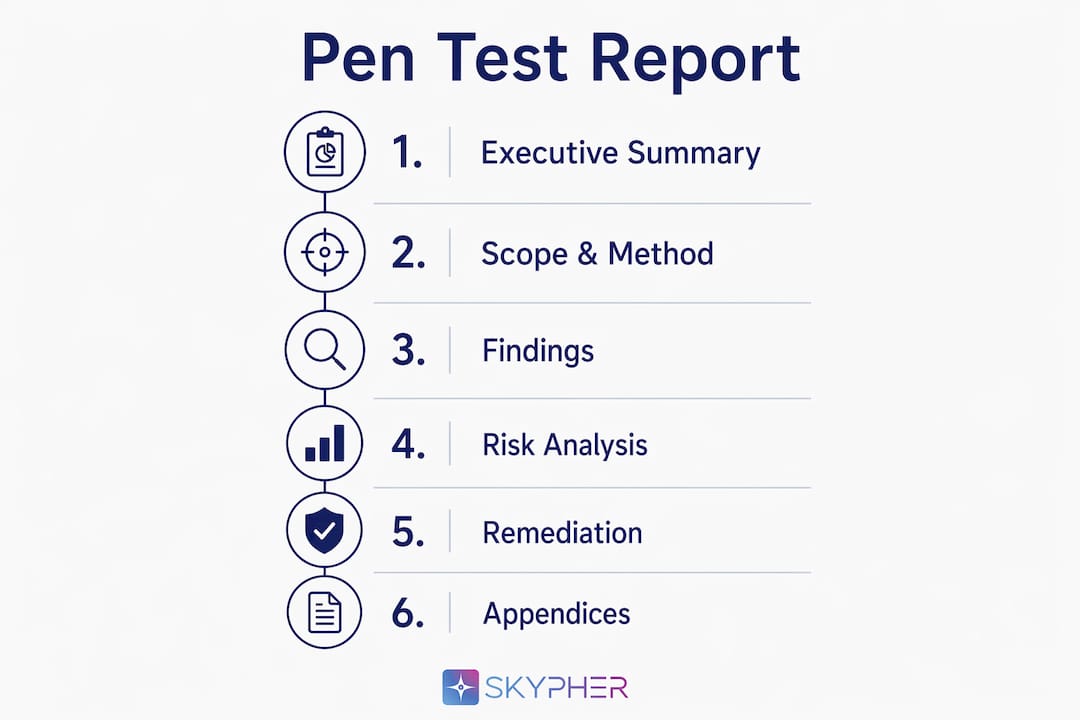
A standard penetration testing report in 2026 includes six core sections. Each section serves a distinct audience and purpose.
- Executive summary: A 2–4 page plain-language overview of critical risks and business impact. It must be self-contained. Board members and executives should understand the risk picture without reading the technical sections.
- Scope and methodology: Defines what was tested, what was out of bounds, and which techniques and tools the team used. This section protects both the tester and the client.
- Findings and vulnerabilities: The technical core of the report. Each finding follows a standardized format covering title, severity, affected systems, and reproduction steps.
- Risk assessment: Uses CVSS 4.0 scoring to rate severity. Scores must be accompanied by a business impact statement, not just a number.
- Evidence documentation: Screenshots, logs, and proof-of-concept code that verify each finding. Evidence must be clear enough for a developer to reproduce the issue independently.
- Remediation recommendations: Specific, prioritized guidance for each finding. Generic advice like "patch the system" is not acceptable.
Pro Tip: Write the executive summary last. Once you know the full scope of findings, you can accurately prioritize which risks deserve leadership attention.
The table below shows how each section maps to its primary audience.
| Report section | Primary audience |
|---|---|
| Executive summary | C-suite, board, auditors |
| Scope and methodology | Security managers, compliance teams |
| Findings and vulnerabilities | Developers, system administrators |
| Risk assessment | IT leadership, risk officers |
| Evidence documentation | Technical remediation teams |
| Remediation recommendations | DevOps, IT operations, architects |
How to write standardized, actionable findings
Every finding in a penetration test report must follow a consistent structure. Inconsistency forces developers to hunt for information, which slows remediation.
- Finding title and severity rating. Use a clear, descriptive title such as "Unauthenticated SQL Injection on Login Endpoint." Assign a severity rating of Critical, High, Medium, or Low based on the CVSS 4.0 score.
- Full CVSS vector string. Include the complete vector string, not just the numeric score. This gives developers and security architects the context to understand exactly which attack factors drove the rating.
- Technical description. Write for the developer who will fix the issue. Explain what the vulnerability is, where it exists, and why it is exploitable. Avoid assuming the reader has your testing context.
- Reproduction steps. Reproducible steps are critical for remediation quality. Write them at copy-paste quality. If a developer cannot reproduce the issue in under ten minutes, the steps are not good enough.
- Evidence. Attach a screenshot or log excerpt that confirms the finding. Label every piece of evidence clearly so it maps back to the specific finding.
- Business and operational impact. State what an attacker could achieve by exploiting this vulnerability. "An attacker could exfiltrate the customer database" is more useful than "data may be at risk."
- Specific remediation advice. Effective remediation recommendations include operational context. For example: "Patch requires a scheduled outage window" or "Implement an IPS signature as a temporary workaround until the patch is applied."
Pro Tip: Template your finding format before the engagement starts. Filling in a consistent structure during testing is far faster than reformatting notes after the fact.
Human testers add value that automated scanners cannot replicate. Skilled testers chain low-severity issues into realistic high-impact attack paths, exposing business logic flaws that no automated tool detects. Your findings section must capture that chain, not just list individual vulnerabilities in isolation.

What are best practices for communicating risks in pen test reports?
Risk communication is where most penetration testing reports fail. Technical accuracy is necessary but not sufficient. The report must also be readable and persuasive to non-technical stakeholders.
Neutral, impact-focused language is the foundation of effective risk communication. Accusatory phrasing creates defensiveness and slows remediation. The fix is straightforward: replace blame with description.
Replace "You failed to secure the database" with "The database was accessible externally without authentication, posing an exfiltration risk." The second version describes the problem without assigning fault, making it easier for IT teams to act.
Several practices consistently improve how risks land with both technical and executive audiences.
- Highlight chained attack paths. A single low-severity finding rarely alarms anyone. Show how an attacker chains a version disclosure finding with a known CVE to gain initial access. That narrative changes the conversation.
- Address low-severity findings explicitly. Software version disclosures are often dismissed as minor. They are not. They give attackers a direct roadmap to applicable CVEs and initial access vectors.
- Translate technical impact into business terms. Frame findings around confidentiality, integrity, and availability. "This vulnerability allows an attacker to modify financial transaction records" lands harder than "this is a High-severity injection flaw."
- Keep the executive summary focused. Over-explaining minor attack chains in the executive summary dilutes focus on critical risks. Prioritize the findings that demand immediate executive attention.
- State what was not found. A clear summary of what was tested and what showed no exploitable weakness builds credibility and gives leadership a complete picture.
Staying current on cybersecurity risk trends helps you frame findings in the context of the threat landscape your client actually faces, which makes the report more persuasive.
How to standardize and speed up the report writing process
Penetration tests typically take 1–3 weeks, with an additional 1–2 weeks for reporting. That reporting window is where quality often degrades under deadline pressure.
The single most effective change is standardizing proof-of-concept capture during the test itself. Consistent PoC capture and standardized instructions can cut report generation time from the industry average of 8–12 hours to under 1 hour per engagement. That is not a minor efficiency gain. It frees senior testers to focus on analysis rather than formatting.
| Approach | Time to complete report | Risk of missing evidence |
|---|---|---|
| Ad hoc notes, post-test formatting | 8–12 hours | High |
| Standardized templates, PoC captured during test | Under 1 hour | Low |
Templates are the foundation of this approach. A good template enforces the six-section structure, pre-populates the CVSS scoring fields, and includes placeholder prompts for evidence and reproduction steps. Testers fill in the template as they work, not after.
Automated tools can assist with formatting and CVSS scoring, but they do not replace human analysis. No tool identifies a chained attack path or translates a technical finding into a board-level business impact statement. Use automation for structure and leave judgment to the tester.
Pro Tip: Build a finding library from past engagements. Common vulnerabilities like default credentials or missing HTTP security headers appear repeatedly. A pre-written, reviewed finding entry cuts writing time and improves consistency across reports.
For a deeper look at how professional pen testing structures the full engagement, including scoping and methodology decisions that directly affect report quality, that guide covers the end-to-end process.
Key Takeaways
A penetration test report is only as valuable as its clarity, structure, and the specificity of its remediation guidance.
| Point | Details |
|---|---|
| Six-section structure | Every report needs an executive summary, scope, findings, risk assessment, evidence, and remediation sections. |
| CVSS 4.0 with context | Always include the full vector string and a business impact statement alongside the numeric score. |
| Neutral language | Replace accusatory phrasing with impact-focused descriptions to accelerate remediation cooperation. |
| Standardize during testing | Capturing PoC and filling templates during the engagement cuts report time from 8–12 hours to under 1 hour. |
| Chain low-severity findings | Show how minor issues combine into realistic attack paths to communicate true risk to leadership. |
Why the report is the real product of a pen test
Security professionals often treat report writing as the administrative tail end of an engagement. That framing is wrong, and it costs clients real money.
The penetration test itself lasts days or weeks. The report lasts years. Clients use it for audits, board presentations, remediation tracking, and regulatory submissions. Clear reporting accelerates remediation and risk reduction in ways that even a technically brilliant test cannot achieve if the findings are buried in jargon.
The most common failure I see is underestimating how long good reporting takes. Teams budget two days and deliver a rushed document that developers cannot act on. The remediation stalls. The risk persists. The client paid for a test but got no measurable security improvement.
The second failure is writing for one audience. A report that satisfies a developer will overwhelm a CFO. A report written for the board will frustrate the engineer trying to reproduce a finding. The six-section structure exists precisely to solve this problem. Each section speaks to a different reader without requiring anyone to wade through content that is not relevant to them.
Retesting is the final piece most reports omit. A good report includes explicit guidance on what to retest after remediation and what evidence to collect to confirm a fix. Without that, the engagement ends without a closed loop, and the client has no way to verify their exposure has actually decreased.
— Gaspard
How Skypher supports your security posture after the pen test

A penetration testing report identifies gaps. Closing those gaps requires ongoing security data management, including responding to vendor questionnaires, customer security reviews, and compliance audits that reference your test results. Skypher's AI Security Questionnaire Automation tool connects directly to that workflow. It integrates with over 40 third-party risk management platforms, including OneTrust and ServiceNow, and can answer 200 security questions in under one minute. Teams using Skypher pull verified findings from their security documentation directly into questionnaire responses, cutting review cycles from days to hours. For organizations managing multiple products or entities, Skypher's multilingual support and enterprise-grade setup handle the complexity without adding headcount.
FAQ
What is a penetration test report?
A penetration test report is the formal deliverable of a pen testing engagement. It documents exploited vulnerabilities, attack paths, risk ratings, and specific remediation steps for technical teams and leadership.
How is a penetration testing report different from a vulnerability assessment?
A vulnerability assessment lists potential weaknesses identified by automated scanning. A penetration testing report documents actual exploitation, proving that a vulnerability is exploitable and showing its real business impact.
What does a good executive summary include?
A good executive summary is 2–4 pages of plain language covering critical risks, business impact, and priority remediation actions. It must be self-contained so executives understand the risk picture without reading the technical sections.
How long does it take to write a penetration test report?
Without standardized templates and PoC capture, report writing typically takes 8–12 hours per engagement. With standardized processes in place, that time drops to under 1 hour while maintaining thoroughness.
What is CVSS 4.0 and why does it matter in pen test reports?
CVSS 4.0 is the current industry standard for scoring vulnerability severity. Including the full CVSS vector string in each finding gives developers and architects the context to understand which attack factors drove the rating, making remediation decisions more accurate.