
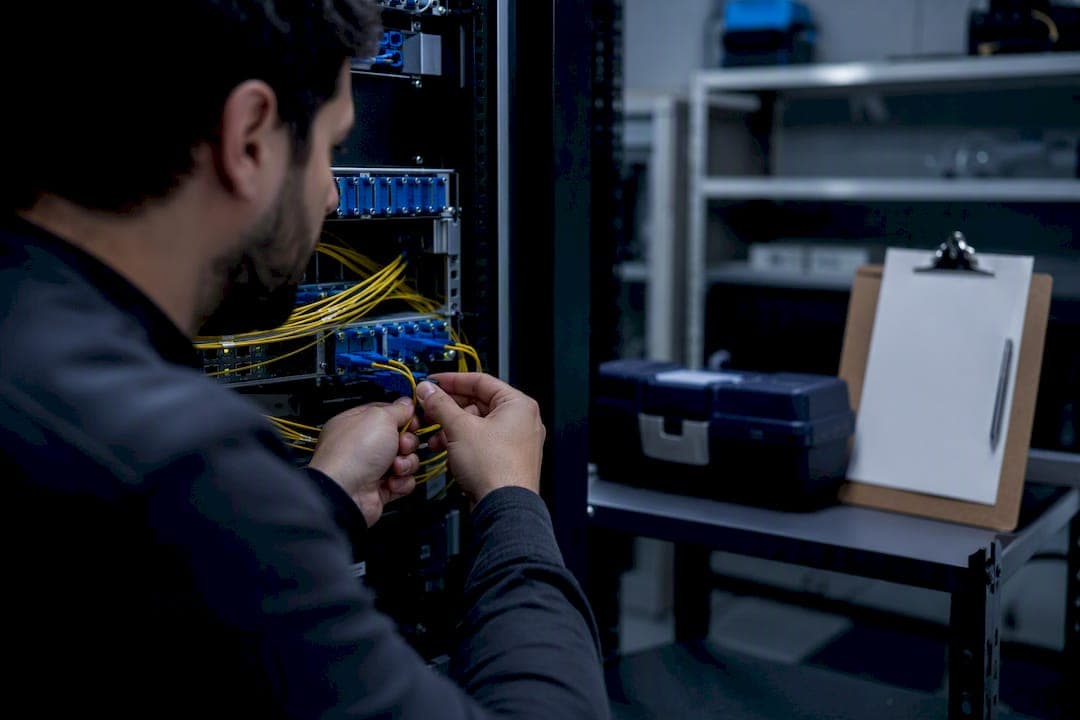
In this context, "ISMS software" means security-questionnaire automation software, not ISO 27001 management-system tooling. If your team spends days chasing subject-matter experts to answer the same vendor security questions, this software category exists to fix that: it generates evidence-backed responses in hours, cuts follow-up rounds, and speeds up deal cycles. Your next move should be evaluating vendors against the checklist below.
TL;DR:
- Automated responses can cut questionnaire completion time by up to 70 percent, saving hundreds of hours annually for high-volume teams.
- Key features include parsing various formats, matching answers from a maintained library, attaching evidence automatically, and routing questions to appropriate experts.
- Pilots should test the software on complex, custom questionnaires and aim for setup in 8 to 12 hours, measuring time saved and decrease in follow-up requests.
- Integration with GRC, TPRM, collaboration, and evidence management tools is critical; skipping these reduces answer verification and auditability.
- Failure to build a comprehensive response library, attach evidence, and enforce governance risks answer accuracy and compliance over time.
Table of Contents
- What Does ISMS Software Actually Automate?
- How Much Time and Money Does Automation Actually Save?
- Who Should Buy This and Who Should Own It?
- How Do You Evaluate and Pilot ISMS Software?
- What Integrations Actually Matter for Evidence and Governance?
- What Does a Realistic Rollout Timeline Look Like?
- What Do Teams Get Wrong When Adopting This Software?
- Why Skypher Is Built for This, and How to Start
- Sources
What Does ISMS Software Actually Automate?
The term causes real confusion. Search for "ISMS software" and you will find plenty of content about implementing ISO/IEC 27001 management frameworks. That is not what this article covers. Here, ISMS software refers to platforms that read incoming security questionnaires and RFPs, then generate accurate, evidence-linked answers automatically.
A capable platform needs to do four things well:
- Parse every format. SIG, CAIQ, VSAQ, custom Excel and Word documents, PDF exports, and even direct portal uploads should all ingest cleanly, and the system should detect question intent even when wording varies from questionnaire to questionnaire.
- Match answers from a governed library. Retrieval AI pulls from a maintained response bank rather than guessing, and flags confidence levels so reviewers know which answers need a second look.
- Attach evidence automatically. Every answer should carry a linked SOC 2 report excerpt, policy document, or certification, with version history tracked for audits.
- Route to the right reviewer. Subject-matter experts see only the questions that need their eyes, with approval workflows and multilingual support for distributed teams.
Skip any one of these and the tool becomes a faster way to produce answers nobody can verify. That defeats the purpose.
How Much Time and Money Does Automation Actually Save?
The numbers here are not marginal. Manual security questionnaires typically consume 40 to 80 hours per submission, split across a security lead pulling evidence, a compliance reviewer checking accuracy, and a sales rep chasing deadlines. Automation routinely cuts that by 65 to 80 percent, turning a week of back-and-forth into an afternoon.
The math that matters: A team processing 15 questionnaires a quarter at 60 hours each is spending 900 hours a year on this task alone. Cut that by 70 percent and you get back roughly 630 hours, without adding headcount.
Three effects compound to produce that outcome:
- Evidence attached at the point of answer generation short-circuits the "can you send documentation" follow-up email that stalls procurement by days.
- A governed response library means the second questionnaire from a similar buyer takes less time than the first, and the tenth takes even less.
- Reduced SME interruption means security and compliance staff spend fewer hours context-switching away from actual risk work.
That last point rarely makes it into vendor pitches, but it is often the real budget justification.
Who Should Buy This and Who Should Own It?
Volume is the clearest signal. If your organization handles fewer than 10 questionnaires a quarter, a well-organized shared drive and a checklist might still get you by. Cross that threshold, and manual handling starts eating disproportionate time from your most expensive people.
Ownership typically splits three ways:
- Security or compliance owns the response library, evidence accuracy, and audit trail.
- Sales or presales drives usage, since faster turnaround directly shortens deal cycles and reduces the "security review" bottleneck that stalls late-stage pipeline.
- IT or GRC teams manage the integrations that keep evidence current.
A Trust Center alone will not solve this for you. It deflects generic, repeatable questions well, but custom questionnaires, portal-based assessments, and anything requiring a tailored answer still need active processing behind the scenes.
How Do You Evaluate and Pilot ISMS Software?
Vendor demos all look impressive. The differences show up during a real pilot, so run one before you sign a multi-year contract.
Evaluate vendors against these criteria first:
- Evidence linking depth. Can answers pull directly from your GRC platform, or does someone still have to manually attach documents?
- Format coverage. Does it genuinely handle your hardest questionnaire type, not just the easy SIG-Lite ones?
- Integration breadth. Does it connect to the TPRM, collaboration, and document tools your team already uses daily?
- SME routing logic. Can you configure who reviews what, and does it respect your existing approval hierarchy?
- Audit trail completeness. Can you reconstruct who approved which answer, and when, six months later?
For the pilot itself, ingest one or two real questionnaires, ideally including at least one large custom assessment. Validate autofill accuracy against what a human would have written, then measure two things: hours of SME time saved, and whether follow-up requests from the buyer dropped compared to your historical average.
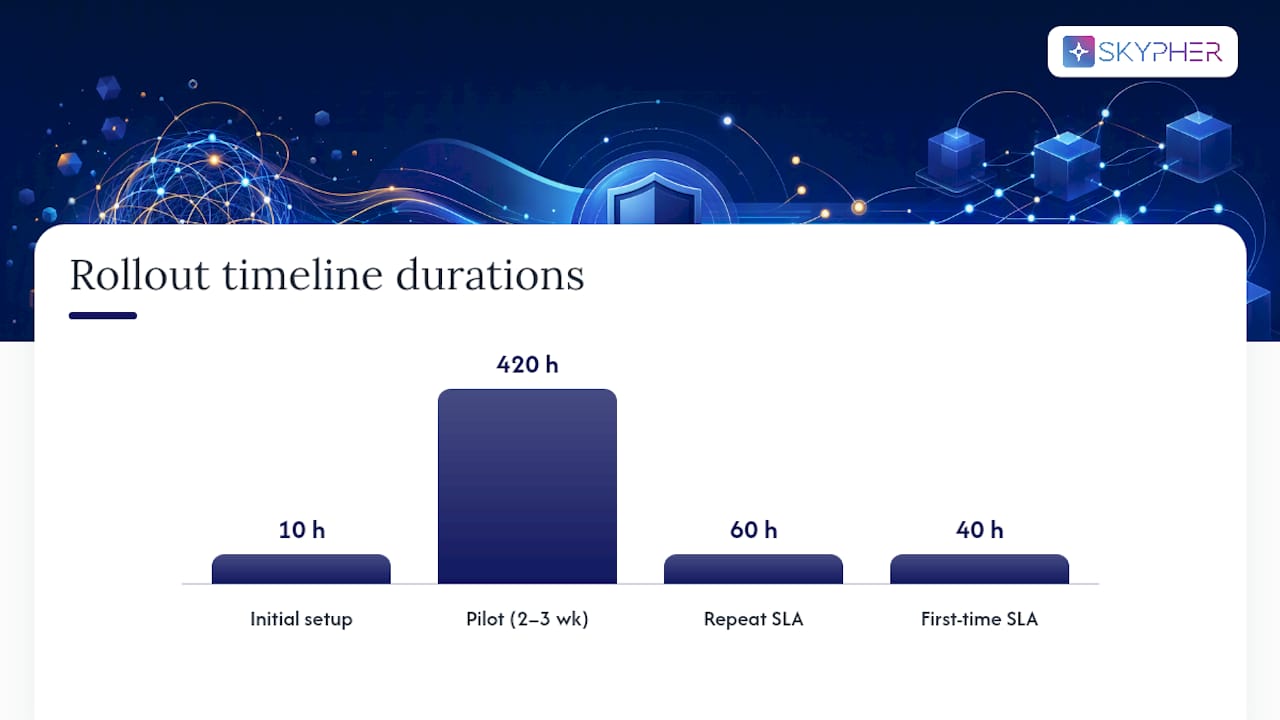
Expect initial setup to run 8 to 12 hours, covering library construction, evidence linking, and permission configuration, based on documented implementation timelines for questionnaire automation.
Pro Tip: Run your pilot on the ugliest, most custom questionnaire you have on file, not the simplest one. If the tool handles your worst case well, everything easier is a bonus.
What Integrations Actually Matter for Evidence and Governance?
Not all integrations carry equal weight. Some are cosmetic; others determine whether your answers hold up under buyer scrutiny.
Check these categories specifically:
- GRC and TPRM connectors — OneTrust, ServiceNow, and similar platforms need to sync evidence bidirectionally, not just export a static file once.
- Collaboration tools — Slack, Microsoft Teams, Confluence, Google Drive, OneDrive, and SharePoint integrations determine how much friction your SMEs face when a question lands in their queue.
- Evidence signing and versioning — every attached document should carry a timestamp and reviewer sign-off, since buyers verify evidence against live compliance data far more often than they used to.
- Trust Center publishing — automation handles the custom, one-off questions; a Trust Center handles the repetitive ones buyers ask before they even reach out.
Skip evidence linking and you get answers that look complete but fail verification the moment a buyer's security team pushes back, generating exactly the follow-up cycle you bought the software to eliminate.
What Does a Realistic Rollout Timeline Look Like?
Setup takes days, not months, if you scope the pilot correctly. Here is the typical arc:
- Week 1: Library build and evidence linking (8 to 12 hours of focused work).
- Weeks 2 to 3: Pilot on one or two live questionnaires, including SME review.
- Month 2 onward: Steady-state processing, with the library improving after each submission.
A documented example of a 187-question custom assessment processed end-to-end in roughly two hours, including SME review, shows what steady-state looks like once the library matures. That is the compounding effect in action: the fiftieth questionnaire draws on answers refined by the previous forty-nine.
For sales engagement, a reasonable internal SLA is 48 to 72 hours turnaround for repeat buyers and five business days for first-time custom submissions.
What Do Teams Get Wrong When Adopting This Software?
The biggest mistake I see is treating the initial library build as optional homework instead of the actual product. Teams buy the tool, skip evidence linking to save time, and end up with fast, confident-sounding answers that collapse the moment a buyer asks for supporting documentation. Automation without evidence attachment is just a faster way to generate liability.
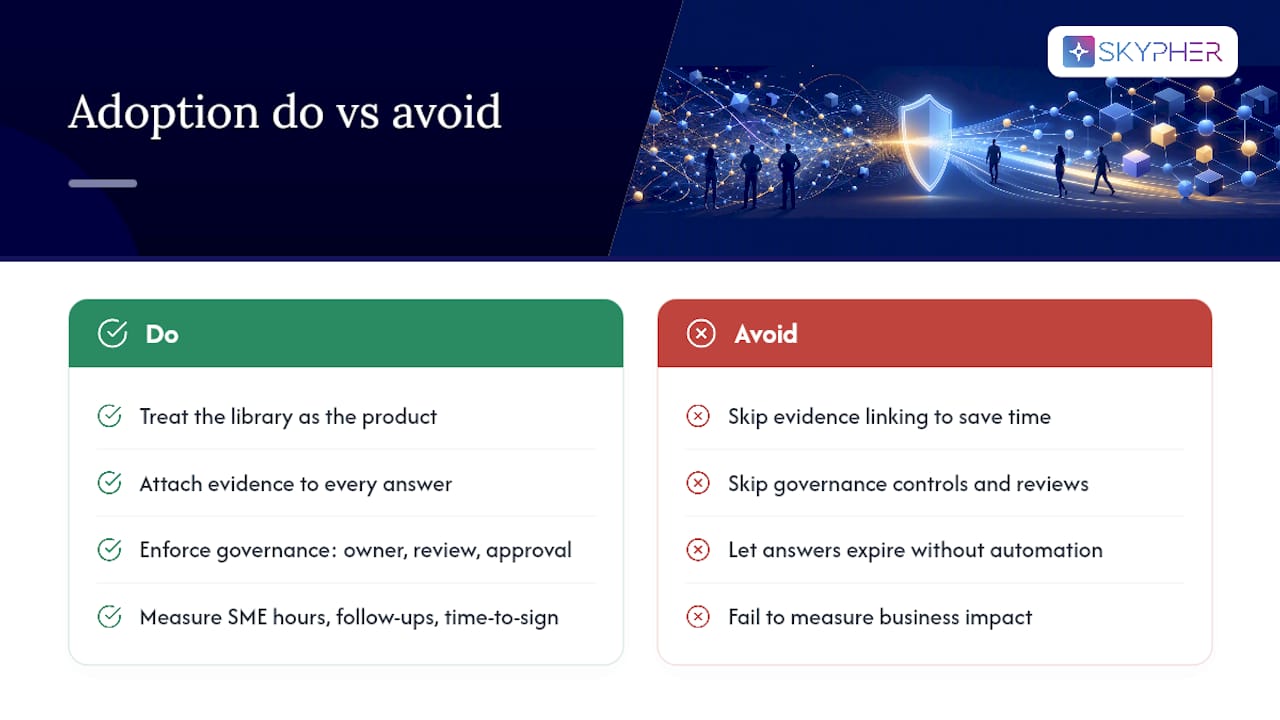
The second mistake is skipping governance. Every answer needs an owner, a last-reviewed date, and an approval status, with automated expiration so stale answers get flagged for re-review when policy or evidence changes. Without that, your response library rots quietly and nobody notices until an outdated answer goes out to a Fortune 500 buyer.
Win internal stakeholders early by measuring the right things: SME hours saved per questionnaire, the drop in buyer follow-up requests, and time from submission to signature. Those three numbers make the business case for you.
— Gaspard
Why Skypher Is Built for This, and How to Start
Skypher runs on proprietary retrieval AI that parses every questionnaire format, from SIG and CAIQ to messy custom PDFs, and can answer up to 200 questions in under one minute during bulk operations. It connects to more than 40 third-party platforms, including OneTrust, ServiceNow, Slack, Microsoft Teams, Salesforce, Notion, Confluence, and SharePoint, so evidence stays current without manual re-uploads. A customizable Trust Center handles the repetitive asks, while the core automation tool handles everything custom.

A pilot typically follows the timeline above: setup in 8 to 12 hours, first measurable ROI after one or two processed questionnaires, and confidence scoring that tells your SMEs exactly which answers need review versus which are ready to send. Teams building multi-entity or multi-product setups can lean on Skypher's AI recommendation engine to keep answer accuracy high even as complexity grows. If your queue of open questionnaires is already backing up, request a demo and run your worst questionnaire through it first.
Sources
For evidence-linking practices tied to compliance frameworks, see ISO 27001 compliance and questionnaire automation. For broader SaaS security context, review this 2026 SaaS security guide and TrailerCast's security practices.
- Security Questionnaire Automation Guide | Cyber Defense Agent
- How to Answer an Enterprise Security Questionnaire: A Worked Example | vCISO Lite
- Security Questionnaire Automation: How to Cut Response Time by 80% - Integrated GRC Platform for Compliance, Risk & Security Governance