

When a customer or auditor asks for an "ISO report," they could mean one of two entirely different things: an audit or certification report tied to an ISO management system standard (such as ISO 27001 or ISO 9001), or a claim-history record maintained by the Insurance Services Office used in U.S. property and casualty insurance. For most security questionnaire requests, the first meaning applies. Here is what to do immediately:
- Clarify intent. Ask the requester whether they want a certification document (certificate, audit report summary, or Statement of Applicability), or an Insurance Services Office claim record.
- Verify the source. Confirm the certification body is accredited under ISO/IEC 17021-1 before relying on any certificate.
- Provide the right artifact. Share the certificate and, where permitted, a redacted audit report summary — or explain why the Insurance Services Office record is not relevant to your security posture.
Table of Contents
- What does "ISO report" mean in the United States?
- What an ISO certification audit report actually contains
- How surveillance and recertification audits are scheduled
- How to prepare evidence for a certification audit
- What Insurance Services Office (ISO) reports are and their limits
- How to verify a certification body's credentials
- What to provide when a questionnaire asks for an "ISO report"
- How automation platforms reduce friction on ISO-report requests
- Key Takeaways
- The part most compliance guides skip
- Skypher makes recurring ISO-report requests manageable
- Useful sources
What does "ISO report" mean in the United States?
The label covers two distinct contexts, and conflating them wastes everyone's time.
ISO management system reports are documents produced during or after an audit against a published ISO standard. ISO 27001 (information security), ISO 9001 (quality management), and ISO 22301 (business continuity) are the standards most frequently cited in tech and finance questionnaires. These reports document scope, findings, nonconformities, and corrective actions. Importantly, ISO itself does not issue certificates — independent certification bodies do, and those bodies should be accredited by a national accreditation body.
Insurance Services Office (ISO) reports are something else entirely: a database of property and casualty insurance claim records queried by adjusters using a claimant's name and date of birth. If a vendor-risk team receives a request for an "ISO report" from an insurance adjuster, that is what they are after.
Pro Tip: When a questionnaire asks for an "ISO report," reply with: "Could you clarify whether you need a certification document tied to an ISO management system standard (e.g., ISO 27001 or ISO 9001), or an Insurance Services Office claim record? We will route your request accordingly."
What an ISO certification audit report actually contains
A certification audit report is not the same as the certificate itself. The certificate is a one-page summary; the full audit report is the evidentiary record behind it.
Typical elements of a certification or ISO audit report include:
- Scope statement: the organizational units, processes, locations, and systems covered
- Standard version: e.g., ISO 27001:2022 or ISO 9001:2015
- Audit dates: Stage 1 (documentation review) and Stage 2 (on-site or remote operational audit)
- Findings and nonconformities: major and minor, with clause references
- Corrective-action evidence: documented responses to each nonconformity
- Surveillance schedule: dates for the next annual surveillance audit
- Auditor signature and certification body details: name, accreditation reference, and contact
ISO does not certify organizations. Certification is performed by independent third-party bodies, which should themselves be accredited against ISO/IEC 17021-1 by a national accreditation body such as ANAB (in the United States). A certificate that lacks an accreditation reference is a red flag worth investigating before you rely on it in a customer-facing response.
How surveillance and recertification audits are scheduled
ISO management system certifications follow a three-year cycle. Understanding the timeline helps compliance teams plan evidence collection and avoid the certificate lapses that create questionnaire headaches.
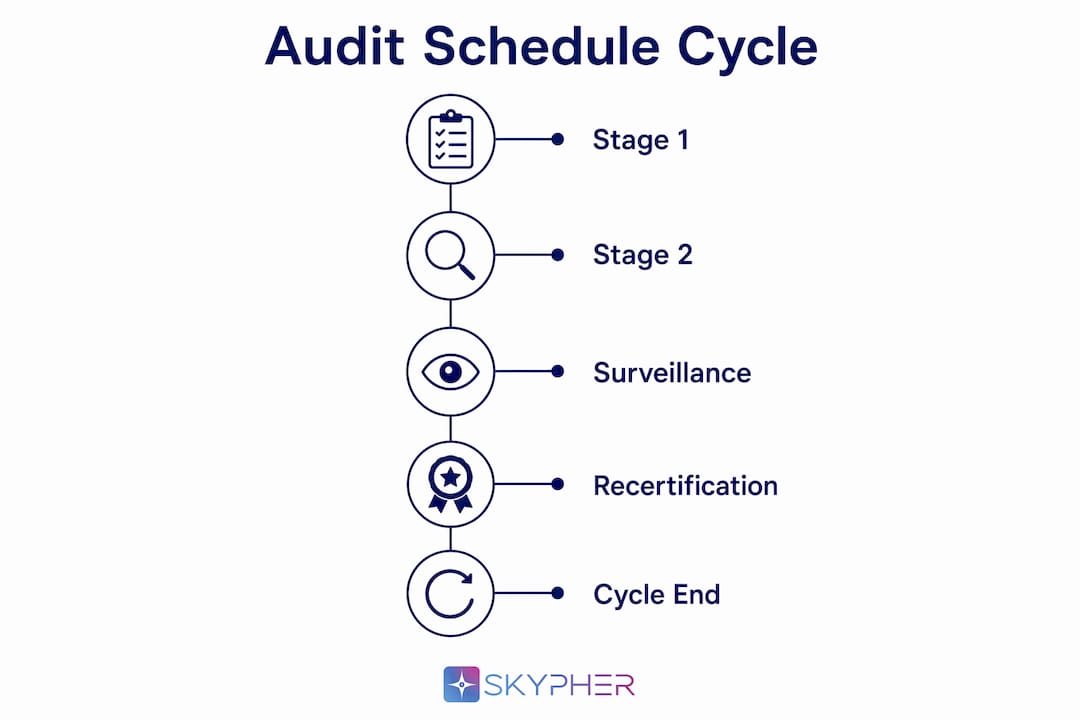
| Audit type | Timing | Approximate audit time |
|---|---|---|
| Stage 1 (documentation review) | Before Stage 2 | Varies by scope and size |
| Stage 2 (initial certification) | After Stage 1 gap closure | Full initial audit time |
| Surveillance audit 1 | Year 1 (approximate first surveillance audit) | ~1/3 of initial audit time |
| Surveillance audit 2 | Year 2 (approximate second surveillance audit) | ~1/3 of initial audit time |
| Recertification audit | Year 3 (before expiry) | ~2/3 of initial audit time |
Surveillance audits sample parts of the management system rather than reviewing it in full, which is why they take roughly one-third of the initial audit time. Recertification is more thorough, at approximately two-thirds of the initial audit time. Missing a surveillance audit or failing to close open nonconformities can lead to certificate suspension or withdrawal — a serious problem when customers are actively querying your certification status.
How to prepare evidence for a certification audit
Auditors are not looking for polished policy documents. They are testing whether your organization actually operates the way those documents describe.

Consistent operational execution is what separates a passing audit from a major nonconformity finding. Auditors sample records, conduct interviews, and look for evidence that controls run continuously — not just at audit time. Paper-only systems fail because the gap between documented procedure and daily practice becomes visible the moment an auditor asks an employee to walk them through a process.
A practical audit-prep sequence, complemented by tools like the structured data LLM audit to ensure schema compliance, includes:
- Define and document scope. Confirm which systems, locations, and processes are in scope and that your scope statement matches operational reality.
- Complete a gap assessment. Map current controls against each clause; assign owners and target dates for remediation. An ISO compliance checklist structured clause by clause is the most efficient tool for this.
- Train your implementation lead. Early training and a thorough gap assessment are the fastest path to first-time certification success.
- Build your evidence map. For each control, record: document name, owner, evidence location (folder path or system), and retention period.
- Run an internal audit. Conduct it at least one full cycle before Stage 2 so you have records showing the system is operational.
- Hold a management review. Document attendance, agenda, decisions, and follow-up actions — auditors check this specifically.
- Close corrective actions. Every finding from the internal audit needs a documented root cause, corrective action, and verification of effectiveness.
Pro Tip: Retention matters as much as content. Auditors expect records spanning the full operating period before Stage 2. A security documentation folder with version-controlled files and clear ownership timestamps is far more convincing than a collection of undated drafts.
What Insurance Services Office (ISO) reports are and their limits
The Insurance Services Office maintains a database of property and casualty insurance claim records. Adjusters query it by name and date of birth to identify prior workers' compensation injuries, auto accidents, or personal injury claims — a routine step when evaluating a new claim.
An Insurance Services Office report is an investigative flag, not adjudicated fact. The database can contain errors, outdated entries, or records from unrelated incidents. Treat any finding as a starting point for verification, not a definitive conclusion. These records carry no legal weight on their own and should never be presented as proof of fraud or prior injury without independent corroboration.
For security and compliance teams, the practical implication is straightforward: if a questionnaire or RFP asks for an "ISO report" and your organization is not an insurance carrier or adjuster, the requester almost certainly means a certification record, not a claim-history database pull. Confirm before you spend time chasing the wrong document.
How to verify a certification body's credentials
Not every certificate is worth the paper it is printed on. A step-by-step verification process protects your team from relying on an unaccredited or out-of-scope certificate.
- Identify the accreditation body. The certificate should name the accreditation body (e.g., ANAB in the U.S.) and carry an accreditation mark.
- Check accreditation to ISO/IEC 17021-1. Accreditation validates the certification body itself; certification validates the organization's management system. Confirm the cert body is listed on the accreditation body's public registry.
- Verify scope match. The certificate scope must cover the systems, services, or locations relevant to your questionnaire. A scope limited to one office or one product line does not cover the rest of the organization.
- Check certificate dates. Confirm the certificate is current and that the next surveillance audit has not been missed.
- Contact the certification body directly. Most accredited bodies offer a certificate verification service. Use it when the stakes are high.
If a certificate lacks an accreditation reference or shows a scope mismatch, request clarification in writing before accepting it as evidence.
What to provide when a questionnaire asks for an "ISO report"
Start with a short clarifying question, then assemble the right artifact package.
Templated clarification message: "Could you confirm whether you are requesting (a) a certification document tied to an ISO management system standard such as ISO 27001 or ISO 9001, or (b) an Insurance Services Office claim record? For (a), we can share our current certificate, an audit report summary, and — for ISO 27001 — our Statement of Applicability."
Shareable artifacts, in priority order:
- Certificate of conformity: current, accredited, with scope and expiry date visible
- Audit report summary (redacted): scope, audit dates, number and classification of findings, corrective-action status — with sensitive operational details removed
- Statement of Applicability (ISO 27001): mandatory for ISO 27001; lists which controls apply and why
- Management review minutes (redacted): evidence that leadership actively governs the management system
- Internal audit summary: demonstrates the system is tested internally between certification audits
- Corrective-action evidence: shows open findings are being tracked and closed
Track every sharing event: who approved the release, what was redacted, and when it was sent. When a full audit report cannot be shared, a signed letter from the certification body confirming current certification status is an acceptable substitute for most questionnaire purposes. For teams managing ISO 27001 security compliance, maintaining a pre-approved artifact package cuts response time significantly.
How automation platforms reduce friction on ISO-report requests
Managing recurring ISO-report requests manually — hunting for the latest certificate version, getting redaction approval, logging what was sent to whom — creates unnecessary risk and delays. Automation platforms address this at the workflow level.
Features that matter most for this use case:
- Centralized artifact storage with version control, so teams always share the current certificate and never accidentally send an expired one
- Access controls and approval workflows that enforce redaction and sign-off before any document leaves the organization
- Templated clarification messages that can be triggered directly from a questionnaire response queue
- Audit trail logging that records who shared what, when, and with which counterparty
- Integrations with enterprise systems (Slack, ServiceNow, OneTrust, and others) so requests flow into existing ticketing and approval processes
Skypher's Trust Center is built for exactly this workflow: centralized artifact management, version-controlled document sharing, and access controls that let you publish a pre-approved evidence package to customers without manual intervention each time. Skypher integrates with over 40 third-party risk management platforms and connects with tools like Slack and ServiceNow, so ISO-report requests that arrive through any channel can be routed, approved, and fulfilled without leaving your existing workflow. To be clear: Skypher is a response-management and evidence-sharing platform. It does not issue ISO certifications.
Key Takeaways
An ISO report request in a security questionnaire almost always means a certification document, not an Insurance Services Office claim record — clarify first, then provide a pre-approved, version-controlled artifact package.
| Point | Details |
|---|---|
| Two distinct meanings | "ISO report" refers to either an ISO management system audit/certification document or an Insurance Services Office claim record — confirm which before responding. |
| ISO does not certify | Certificates are issued by independent certification bodies accredited under ISO/IEC 17021-1, not by ISO itself. |
| Three-year cycle | Surveillance audits run at roughly one-third of the initial audit time; recertification audits run at approximately two-thirds of the initial audit time — missing either risks certificate suspension. |
| Auditors test execution | Consistent operational records, logs, and interview evidence matter more than polished policy documents alone. |
| Skypher for response management | Skypher's Trust Center centralizes certificates and audit artifacts, enforces approval workflows, and logs every sharing event — without issuing certifications. |
The part most compliance guides skip
The biggest operational gap we see is not a missing certificate or a failed audit. It is the absence of a single, standardized internal process for handling the question "Can you send us your ISO report?" Teams scramble, pull different document versions, skip redaction review, and send files with no audit trail. The certification itself may be perfectly valid, but the response process undermines confidence in it.
The fix is simpler than most teams expect: one clarifying question template, one pre-approved artifact package reviewed quarterly, and one approval step before anything goes out. Store everything in a version-controlled location — whether that is a dedicated platform or a well-governed SharePoint folder — and log every release. When your next surveillance audit arrives, that log becomes evidence of consistent operational execution, not just a compliance formality.
Skypher makes recurring ISO-report requests manageable
Every quarter, your team fields the same request: "Can you share your ISO certification?" The manual version of that workflow — finding the right certificate version, getting legal or security sign-off on redactions, emailing the file, and logging what was sent — takes time your team does not have when questionnaire queues are already full.

Skypher gives compliance and security teams a Trust Center where certificates, audit report summaries, and Statements of Applicability live in one version-controlled location, accessible to approved counterparties without a manual hand-off each time. Approval workflows enforce redaction and sign-off before any artifact is shared, and every release is logged automatically for your audit trail. Skypher connects with over 40 TPRM platforms, Slack, ServiceNow, and your existing document repositories — so requests that arrive through any channel get handled consistently. It does not issue ISO certifications; it makes sharing and tracking them far less painful. Request a demo at skypher.co to see how your team can cut ISO-report response time without adding headcount.
Useful sources
| Source | What it covers | When to use it |
|---|---|---|
| ISO.org — Certification | ISO's official position on who issues certificates and the role of accreditation | Confirming that ISO does not certify organizations |
| ISO.org — ISO 9001 explained | Overview of ISO 9001:2015 requirements and certification process | Understanding quality management system scope and audit expectations |
| DNV — Accreditation vs. certification | Explains the difference between accreditation (ISO/IEC 17021-1) and certification | Verifying a certification body's credentials |
| ANAB (anab.org) | U.S. national accreditation body registry for accredited certification bodies | Confirming a cert body is accredited in the United States |
| Insurance Services Office — InjuredWorkersLawFirm | Plain-language explanation of Insurance Services Office claim records | Understanding the insurance-industry meaning of "ISO report" |
| Eurotech — ISO management system guide | Surveillance and recertification audit-time calculations | Planning the three-year certification cycle |
Contact your accreditation body (ANAB for U.S. organizations) to verify a certification body's current accreditation status. Contact the certification body directly to confirm a specific certificate is active and in scope. For Insurance Services Office records, contact the Insurance Services Office or a licensed adjuster — your security team is not the right point of contact for that request.