

TL;DR:
- Party risk encompasses operational, financial, and compliance threats from external vendors and counterparties. Effective management requires tiered assessments, continuous monitoring, and board oversight to prevent systemic instability and regulatory breaches. Organizations that prioritize dynamic governance and tailored evaluations can better mitigate these interconnected risks.
Party risk is the exposure to operational, financial, or compliance harm arising from relationships with external parties, including vendors, suppliers, counterparties, and subcontractors. The Basel Committee on Banking Supervision identifies third-party dependencies as a leading driver of systemic financial instability, particularly when critical service providers are shared across multiple institutions. For corporate risk professionals, managing this exposure requires more than annual vendor reviews. It demands tiered assessment frameworks, SOC 2 report analysis, continuous monitoring, and governance structures that hold boards accountable for risk appetite decisions.
What is party risk and why does it matter?
Party risk is the formal term covering all exposure categories that arise from engaging external parties in business operations. The industry recognizes two primary branches: third-party risk, which covers vendors and suppliers, and counterparty risk, which covers performance obligations in bilateral contracts and financial transactions.
The distinction matters because the controls differ. A vendor delivering cloud infrastructure carries operational and data security risk. A derivatives counterparty carries settlement and default risk. Treating both with the same framework produces blind spots. Risk professionals must treat third parties as extensions of their own operational footprint, not just external service providers.
Regulatory pressure has intensified this requirement. The Office of the Superintendent of Financial Institutions (OSFI) and the Basel Committee both require documented risk appetite statements, board-level oversight, and dynamic response plans covering the full vendor lifecycle. Organizations that lack this structure face both operational exposure and regulatory sanction.
What are the main types of party risk?
Understanding the categories of party risk is the foundation of any effective management program. Each type carries distinct risk sources, impacts, and monitoring requirements.
Third-party risk arises when a vendor, supplier, or service provider fails to deliver as contracted or introduces security vulnerabilities into your environment. A cloud provider outage, a payroll processor data breach, or a logistics partner insolvency all qualify. The key categories include operational disruption, supply chain dependencies, and concentration risk.

Counterparty risk is specific to bilateral contracts and financial transactions. It describes the probability that the other party fails to fulfill its contractual obligations before settlement is complete. This is distinct from credit risk, which measures overall borrower creditworthiness. A company can be solvent yet fail contractual obligations due to liquidity constraints or timing issues.
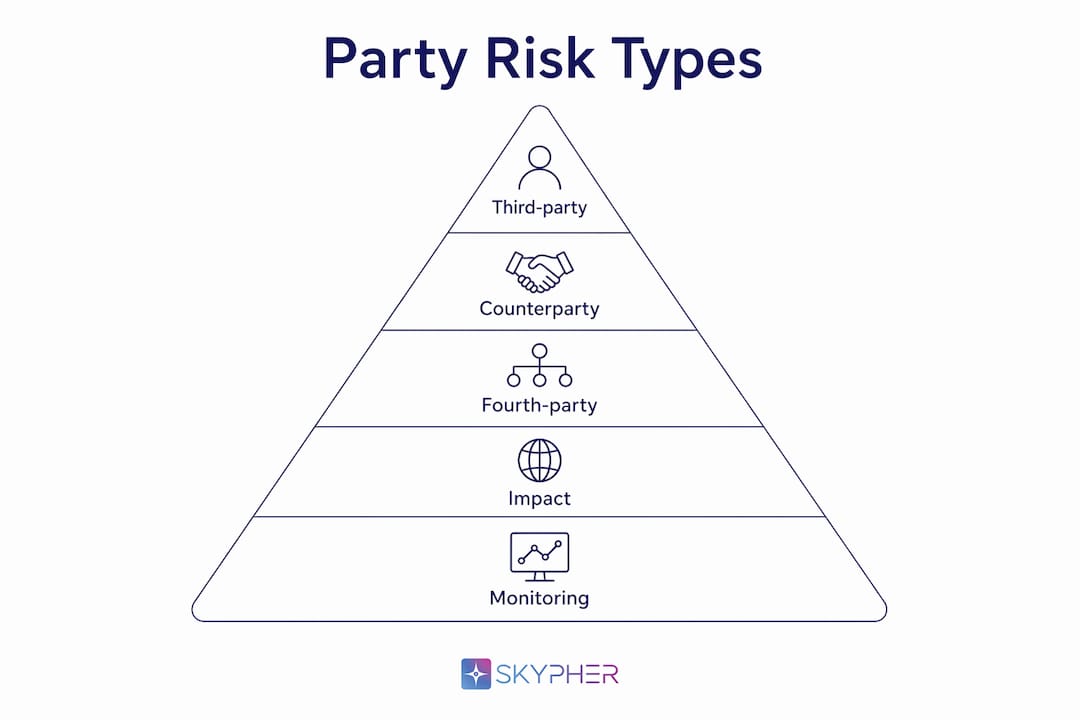
Fourth-party risk is the exposure created by your vendors' own vendors. If your IT provider subcontracts data processing to a third party, that subcontractor's failure becomes your problem. Most organizations have limited visibility into this layer, which makes it the most underestimated category in practice.
| Risk Type | Primary Source | Key Impact | Monitoring Challenge |
|---|---|---|---|
| Third-party risk | Vendor/supplier failure | Operational disruption, data breach | Volume of vendors, questionnaire fatigue |
| Counterparty risk | Contract non-performance | Financial loss, settlement failure | Settlement windows, market volatility |
| Fourth-party risk | Subcontractor failure | Cascading supply chain disruption | Limited visibility beyond Tier 1 |
How do you conduct a third-party risk assessment?
A comprehensive vendor risk assessment follows five structured phases across the vendor lifecycle. Each phase builds on the last, creating a risk profile that evolves rather than stagnates.
-
Sourcing and due diligence. Before onboarding, collect basic vendor information, ownership structure, geographic footprint, and financial stability indicators. This phase sets the baseline for everything that follows.
-
Risk classification. Assign each vendor a tier based on the sensitivity of data they access, the criticality of services they provide, and the regulatory environment they operate in. A Tier 1 vendor with access to customer PII requires far more scrutiny than a Tier 3 office supplies vendor.
-
Evidence collection. Gather SOC 2 Type II reports, penetration test results, and completed security questionnaires. SOC 2 Type II reports provide security assurance over a 12-month period, which is more reliable than point-in-time reviews. Questionnaires should cover information security, physical environment controls, and supply chain resilience.
-
Risk scoring. Calculate both inherent risk (the baseline exposure before controls) and residual risk (the exposure remaining after the vendor's controls are applied). Score across domains including security, compliance, and operational continuity. This dual-score approach reveals where vendor controls are genuinely effective and where gaps remain.
-
Ongoing monitoring. Assign review frequencies based on tier. Tier 1 vendors warrant quarterly reviews and continuous external monitoring. Tier 3 vendors may need only annual check-ins. Continuous external monitoring, including dark web scans for vendor credential breaches, identifies real-time threats that periodic reviews miss entirely.
Pro Tip: Generic questionnaires fail to capture domain-specific risks. Build separate questionnaire templates for SaaS providers, physical logistics vendors, and financial service partners. Tailored assessments improve identification accuracy and reduce false confidence in vendor scores.
Maintaining a dynamic risk profile for each vendor, rather than a static snapshot, is what separates mature TPRM programs from checkbox exercises. The vendor risk review process should update automatically when new evidence arrives, not only at scheduled intervals.
How does counterparty risk work in financial transactions?
Counterparty risk in financial transactions is the probability that the other party defaults or fails to perform between the time a contract is executed and the time it is settled. In securities markets, this window is typically T+1 or T+2 days. During that window, market prices can move, and the counterparty's financial condition can change.
Two techniques directly eliminate settlement exposure. Delivery versus Payment (DvP) synchronizes the transfer of securities with the transfer of cash, so neither party is exposed during the exchange. Payment versus Payment (PvP) applies the same logic to foreign exchange transactions. DvP and PvP eliminate settlement exposure by synchronizing asset exchange, removing the gap where default risk lives.
Central clearing counterparties (CCPs) like the Depository Trust and Clearing Corporation (DTCC) reduce bilateral counterparty exposure by interposing themselves between buyer and seller. Mandatory margining requirements further reduce hidden exposures in derivatives markets. Mandatory central clearing and margining reduce hidden exposures in derivatives markets, particularly for over-the-counter instruments.
Key mitigation techniques for treasury and contracting teams include:
- Netting agreements. Consolidate multiple obligations between two parties into a single net payment, reducing gross exposure.
- Collateral posting. Require counterparties to post margin against open positions, limiting loss in the event of default.
- Credit support annexes (CSAs). Formalize collateral terms within ISDA master agreements for derivatives.
- Counterparty credit limits. Set maximum exposure thresholds per counterparty, reviewed against current market conditions.
Pro Tip: Blockchain and smart contract environments introduce technical counterparty risk. Smart contract vulnerabilities can cause losses even without malicious actors. Treasury teams adopting DeFi or tokenized asset platforms should include smart contract audit reports in their counterparty due diligence process.
The critical distinction for credit risk management teams: counterparty risk is contract-specific and time-bounded, while credit risk is a broader assessment of a borrower's overall ability to repay. Understanding this difference directly affects how treasury teams set exposure limits and structure hedging strategies.
Best practices for mitigating party risk across the enterprise
Effective mitigation of party risk requires governance structures, technology, and operational discipline working together. No single control is sufficient on its own.
Governance and board accountability. Boards are responsible for approving third-party risk strategies aligned with organizational risk appetite and for overseeing performance reporting on critical providers. Senior management translates board-approved risk appetite into operational frameworks covering assessments, controls, and escalation paths. Without this top-down accountability, TPRM programs lack authority and funding.
Tier-based review frequencies. Not every vendor warrants the same attention. A tiering model assigns review depth and frequency based on criticality and data sensitivity. Tier 1 vendors receive continuous monitoring and quarterly reviews. Tier 2 vendors receive semi-annual reviews with automated alerts. Tier 3 vendors receive annual self-assessments. This model concentrates resources where exposure is highest.
Concentration risk management. Overreliance on single or limited vendors creates concentration risk that extends beyond your organization into the broader financial system. When multiple institutions share the same critical service provider, a single failure becomes a systemic event. Risk programs must map concentration exposure across the vendor portfolio and set limits on single-provider dependency for critical functions.
Continuous monitoring technology. Annual or one-time assessments miss fast-evolving risk signals. Real-time data sources, including dark web credential monitoring, automated regulatory change alerts, and financial health indicators, provide early warning that static questionnaires cannot. Early detection via continuous monitoring reduces risk exposure by identifying threats before they materialize into incidents.
Dynamic response planning. TPRM frameworks require board-approved strategies, risk appetite definitions, and ongoing performance monitoring. Response plans must address emerging risks dynamically during the vendor lifecycle, not just at onboarding. Build escalation triggers into vendor contracts so that material changes in a vendor's financial condition, ownership, or security posture automatically initiate a review.
For organizations building or rebuilding their programs, the third-party risk management fundamentals provide a useful baseline before layering in advanced controls.
Key takeaways
Effective party risk management requires tiered governance, tailored assessments, and continuous monitoring rather than periodic reviews alone.
| Point | Details |
|---|---|
| Define risk by type | Third-party, counterparty, and fourth-party risks each require distinct controls and monitoring approaches. |
| Tailor every assessment | Generic questionnaires miss domain-specific risks; build separate templates for each vendor category. |
| Apply DvP and PvP in finance | Synchronizing asset and payment exchange eliminates settlement exposure in financial transactions. |
| Assign board-level accountability | Boards must approve risk appetite and oversee performance reporting on critical third parties. |
| Monitor continuously | Real-time dark web scans and automated alerts catch threats that annual reviews miss entirely. |
The uncomfortable truth about how most organizations manage this
I have reviewed TPRM programs at organizations ranging from regional banks to global technology firms. The pattern is consistent: most programs are built around compliance theater rather than genuine risk reduction. A vendor completes a 200-question questionnaire at onboarding, scores adequately, and then operates without meaningful scrutiny for the next 18 months. Meanwhile, that vendor's security posture degrades, their key personnel turn over, and their own subcontractors change. None of that shows up in the original assessment.
The organizations that actually reduce exposure treat their vendor portfolio the way a portfolio manager treats equities. They monitor continuously, rebalance when risk signals change, and exit positions when the risk-return profile no longer makes sense. That requires technology, but it also requires a cultural shift. Risk teams need to stop defending their questionnaire completion rates and start defending their actual exposure reduction.
The counterparty risk side is equally underserved outside of financial services. I have seen technology companies sign multi-year SaaS contracts with no credit support provisions, no termination triggers tied to financial condition changes, and no concentration analysis. When a critical vendor goes into receivership, the legal team scrambles to find leverage that was never built into the contract.
The practical fix is not complicated. Map your critical vendors. Tier them honestly. Build monitoring into the contract, not just the onboarding checklist. And treat fourth-party exposure as a first-class risk category, not a footnote. The organizations that do this consistently are the ones that avoid the headline incidents.
— Gaspard
How Skypher accelerates party risk assessments
Managing party risk at scale means processing hundreds of security questionnaires without sacrificing accuracy. Skypher's AI-powered recommendation engine automates security questionnaire responses across all major formats, integrates with over 40 TPRM platforms including OneTrust and ServiceNow, and answers up to 200 questions in under one minute. That speed directly reduces the bottleneck that slows vendor onboarding and periodic reviews.

Skypher connects with Slack, Microsoft Teams, Confluence, and SharePoint, so risk teams collaborate in real time without switching tools. The customizable Trust Center gives vendors and auditors a single source of truth for your compliance posture. For corporate risk teams managing large vendor portfolios, Skypher turns a manual, error-prone process into a structured, auditable workflow that scales with your program.
FAQ
What is the difference between party risk and counterparty risk?
Party risk is the broad term covering all exposure from external relationships, including vendors, suppliers, and financial counterparties. Counterparty risk is a specific subset focused on the probability that the other party in a bilateral contract or financial transaction fails to perform before settlement.
How do you assess third-party risk effectively?
A complete third-party risk assessment covers five phases: sourcing, risk classification, evidence collection via questionnaires and SOC 2 reports, residual risk scoring, and ongoing monitoring. Tailored questionnaires by vendor domain produce more accurate results than generic templates.
What is fourth-party risk and why does it matter?
Fourth-party risk is the exposure created by your vendors' subcontractors and suppliers. It matters because a failure two tiers down your supply chain can disrupt your operations just as severely as a direct vendor failure, yet most organizations have no visibility into it.
How do central clearing counterparties reduce financial transaction risks?
Central clearing counterparties like DTCC interpose themselves between buyer and seller in financial transactions, absorbing bilateral counterparty exposure. Combined with mandatory margining, CCPs significantly reduce the hidden default risk embedded in derivatives and securities markets.
What role does the board play in party risk governance?
Boards are responsible for approving the organization's third-party risk strategy and defining its risk appetite. They also oversee performance reporting on critical providers. Senior management implements the operational frameworks that execute against that board-approved strategy.