

No, HIPAA does not cover PCI DSS, and the two are not interchangeable. If your organization handles both protected health information and cardholder data, you almost certainly need to run both compliance programs side by side. The right first move is mapping where payment data and health data actually flow through your systems, so you know exactly which rules apply where.
TL;DR:
- Most organizations handling both PHI and cardholder data must run separate PCI DSS and HIPAA compliance programs, focusing on specific control overlap areas like encryption, access control, and logging.
- PCI enforces strict technical requirements via contracts, while HIPAA offers flexibility through risk-based, addressable controls, leading to different validation and documentation processes.
- Segmentation of networks, tokenization of payment data, and relying on third-party processors significantly reduce scope and exposure for both frameworks.
- A detailed inventory of data flows and a documented control crosswalk are essential to identify gaps and ensure valid, consistent evidence for audits.
- Automation tools can streamline evidence collection and questionnaire responses, saving time and reducing operational risks during dual compliance efforts.
Table of Contents
- Where PCI DSS and HIPAA Actually Overlap
- PCI DSS vs. HIPAA: Prescriptive Rules vs. Risk-Based Judgment
- Who Has to Comply, and Where the Scope Lines Blur
- Building a Control Crosswalk That Actually Holds Up
- When a Breach Hits: PCI and HIPAA Run on Different Clocks
- Your 30 to 90 Day Dual Compliance Checklist
- What Real Breaches Involving PCI and HIPAA Data Teach Us
- What's Changed Recently in Both Frameworks
- How Dual Compliance Reshapes IT Infrastructure
- Where Dual Compliance Efforts Usually Break Down
- Why Documentation Discipline Beats Compliance Theater
- Speeding Up the Evidence Side of Dual Compliance
- Primary Sources Worth Bookmarking
- Sources
- FAQ
Where PCI DSS and HIPAA Actually Overlap
PCI DSS and HIPAA were built for different regulators and different data types, but they lean on a lot of the same security fundamentals. Both frameworks expect a documented risk assessment, access controls that limit who touches sensitive data, encryption for data in transit and at rest, activity logging, and a formal incident response plan. If your team has already built strong access management for HIPAA, most of that architecture transfers directly to your PCI cardholder data environment.
That reuse matters because rebuilding the same controls twice wastes budget and creates inconsistent documentation across audits. The catch is that "similar" does not mean "identical." SecurityMetrics estimates that roughly 70 of the 254 HIPAA Security Rule validation points overlap with PCI DSS, while about 316 of PCI's roughly 1,030 validation points overlap with HIPAA. That leaves a substantial share of each standard's requirements standing entirely on their own.
Shared control areas worth building once and reusing include:
- Risk assessment methodology and documentation templates
- Role-based access control and least-privilege policies
- Encryption standards for data at rest and in transit
- Centralized logging and audit trail retention
- Incident response and escalation procedures
PCI DSS vs. HIPAA: Prescriptive Rules vs. Risk-Based Judgment
The biggest operational difference between the two standards is philosophy. PCI DSS tells you exactly what to do. The PCI Security Standards Council spells out specific technical requirements, firewall configuration rules, mandatory multifactor authentication, and quarterly vulnerability scans by an Approved Scanning Vendor. HIPAA works differently. It asks you to implement "reasonable and appropriate" safeguards and labels many specifications as "addressable" rather than strictly "required," meaning you can choose an alternative control if you document why it fits your risk profile.
That flexibility sounds easier, but it often creates more paperwork, not less. HIPAA Journal notes that PCI's prescriptive technical controls contrast sharply with HIPAA's judgment-based approach, and unfunded or undocumented risk decisions are exactly what draws scrutiny during an OCR investigation.
Enforcement differs just as much as the requirements themselves:
- PCI DSS is enforced contractually by acquiring banks and card brands (Visa, Mastercard, and others), with penalties built into merchant agreements.
- HIPAA is enforced by HHS Office for Civil Rights under federal statute, with fines set by law.
- Validation for PCI runs through Self-Assessment Questionnaires, a Report on Compliance from a Qualified Security Assessor, or ASV scans, depending on transaction volume.
- Validation for HIPAA runs through a documented risk analysis, policy review, and, when triggered, an OCR audit or investigation.
Who Has to Comply, and Where the Scope Lines Blur
HIPAA applies to two groups: covered entities (health plans, providers, and clearinghouses) and their business associates, which HHS defines as any organization handling PHI on a covered entity's behalf. PCI DSS applies far more broadly. Any entity that stores, processes, or transmits cardholder data, from a hospital billing office to a third-party payment processor, falls inside PCI's scope regardless of industry.
The gray area healthcare organizations trip over most is payment data embedded inside a medical record. TechTarget's analysis of PCI compliance in healthcare points out that whether a card number counts as PHI depends on how it's stored and used. A cardholder number sitting inside a patient's designated record set, tied to their billing history, is PHI. The same number sitting isolated in a payment gateway, disconnected from clinical data, is purely PCI's concern.
Three scoping moves shrink your exposure on both fronts at once:
- Segment your cardholder data environment away from clinical systems using network segmentation, so a breach in one doesn't automatically expand the scope of the other.
- Tokenize payment data at the point of capture so raw card numbers never touch systems that also hold PHI.
- Route payment processing through a PCI-validated third party rather than storing card data in-house, which shrinks your own PCI footprint substantially.
Building a Control Crosswalk That Actually Holds Up
Start with an honest inventory. You cannot map controls until you know where payment data and PHI actually live, move, and get backed up. Walk every system, vendor connection, and data store, and tag each one as PCI-relevant, HIPAA-relevant, or both.
Once that inventory exists, build a crosswalk that lines up each PCI requirement against its closest HIPAA counterpart, then flags the gaps. Where HIPAA's addressable specification lets you choose a compensating control instead of PCI's exact prescription, document the rationale in writing. As one analysis of HIPAA's flexible language points out, treating "addressable" as optional rather than as "must be justified in writing" is one of the most common reasons organizations get burned during an OCR review.
Evidence expectations diverge here too. PCI assessors want technical proof: scan reports, firewall configs, QSA attestations. HIPAA reviewers want risk-analysis documentation, signed business associate agreements, and policy records showing you considered alternatives before choosing a safeguard.
- Inventory data flows before mapping any controls
- Build a written crosswalk, not a mental one
- Document compensating controls and the reasoning behind them
- Store PCI and HIPAA evidence in one central repository, not two
Pro Tip: Keep a single evidence library tagged by both PCI requirement number and HIPAA safeguard, so when an auditor or a customer questionnaire asks for proof, you're pulling from one source instead of reconstructing it each time.
Given that only a partial slice of each framework's validation points overlap, expect real, separate work on both sides, even with a strong crosswalk in place.
When a Breach Hits: PCI and HIPAA Run on Different Clocks
A single compromise touching both card data and PHI triggers two separate response tracks with two separate deadlines, and confusing them costs organizations valuable time. PCI's ecosystem moves fast. You typically need to notify your acquiring bank and the card brands within days, and if a forensic investigation is required, industry guidance points to engaging a PCI Forensic Investigator within roughly five business days. HIPAA moves on a slower, statutory clock. Covered entities have up to 60 days from discovery to notify affected individuals and HHS OCR.
A response checklist that satisfies both simultaneously looks like this:
- Contain the incident and preserve forensic evidence immediately, before either clock starts influencing decisions
- Determine scope: which systems held PAN, which held PHI, and where they overlapped
- Notify your acquirer and card brands within the contractually required window
- Notify HHS OCR and affected individuals within the 60-day HIPAA deadline
- Engage a PCI Forensic Investigator if card data exposure is confirmed or suspected
- Document remediation for both your PCI Report on Compliance and your HIPAA risk analysis update
Your 30 to 90 Day Dual Compliance Checklist
Trying to tackle both frameworks at once without sequencing creates chaos. Prioritize in phases instead.
- Days 1 to 30: Map every data flow touching PAN or PHI, confirm business associate agreements are current, segment your cardholder data environment, and run your quarterly ASV scan alongside a fresh HIPAA risk assessment.
- Days 30 to 60: Roll out multifactor authentication and encryption everywhere gaps surfaced, centralize logging across both environments, and finish your written control crosswalk with documented rationale for every addressable HIPAA item.
- Days 60 to 90: Schedule your next SAQ or RoC cycle, set a recurring HIPAA risk-review cadence, and put continuous monitoring in place so neither program lapses between formal assessments.
Pro Tip: Treat the 90 day mark as a checkpoint, not a finish line. Both frameworks expect ongoing monitoring, not a once-a-year sprint, so build the review cadence into your calendar now rather than reconstructing it under audit pressure later.
What Real Breaches Involving PCI and HIPAA Data Teach Us
Healthcare breaches involving payment systems tend to follow a familiar pattern: a vendor connection or a legacy system nobody fully mapped becomes the entry point. Hospital billing departments are frequent targets precisely because they sit at the intersection TechTarget describes, where clinical and payment systems are rarely completely separated. When attackers breach a hospital's billing platform, they often walk away with both card numbers and the medical record data those numbers are tied to, triggering obligations under both frameworks simultaneously.
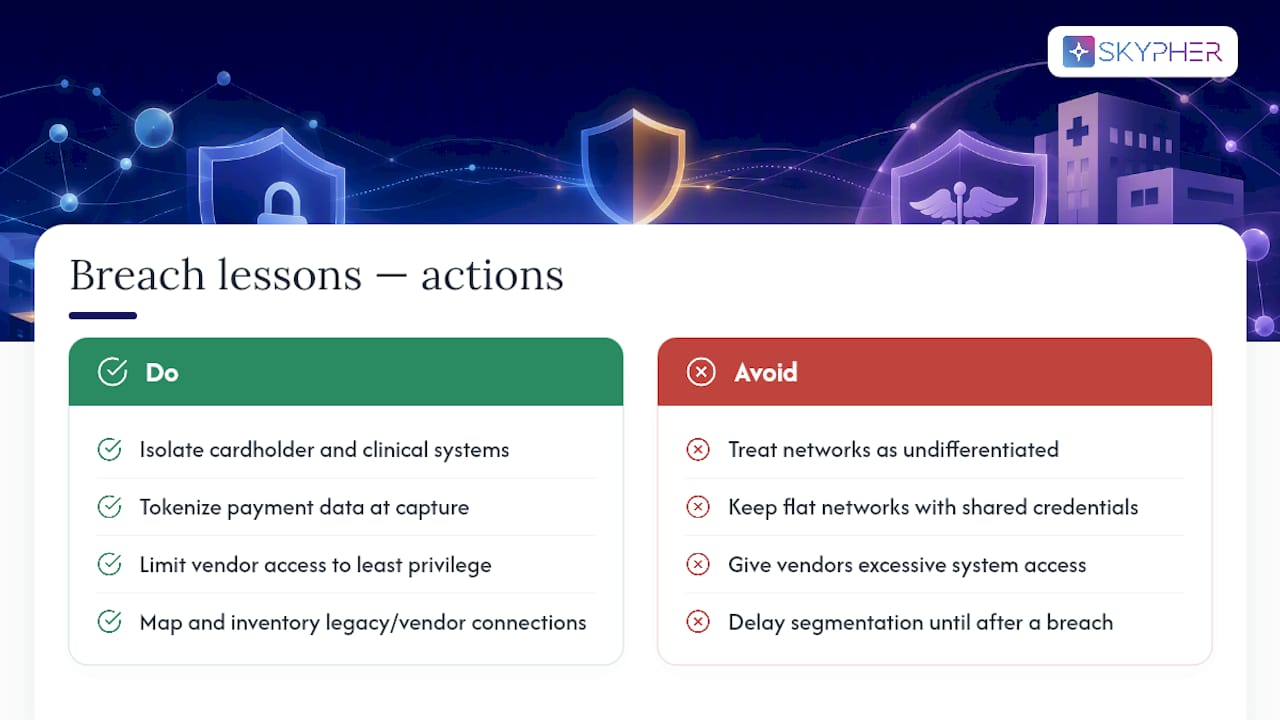
The recurring lesson across healthcare incidents involving payment data is that segmentation failures, not sophisticated attacks, cause most of the damage. When card processing systems sit on the same flat network as electronic health records, a single compromised credential can expose both data types at once, turning what might have been a contained PCI incident into a full HIPAA breach notification event. Third-party vendor access is the second recurring theme. Business associates and payment processors often hold broader system access than their actual job requires, and that excess access becomes the path attackers use once they're inside.
The practical takeaway is not to wait for the aftermath to build segmentation. Organizations that isolate their cardholder data environment from clinical systems, tokenize payment data at capture, and limit vendor access to only what's necessary shrink the blast radius dramatically if a breach does occur. The ones that treat both networks as one undifferentiated environment are the ones facing dual notification obligations after a single incident.
What's Changed Recently in Both Frameworks
PCI DSS continues to tighten its technical requirements with each version update, pushing organizations toward stronger authentication and more granular monitoring of cardholder data environments. The PCI Security Standards Council's document library stays current with the latest version and assessor guidance, and it's worth checking before your next assessment cycle rather than relying on last year's checklist.
HIPAA enforcement has also shifted in tone. HHS OCR has increasingly focused audits on whether organizations documented their reasoning for addressable safeguards, not just whether they implemented some safeguard. That shift raises the bar on paperwork discipline for any organization treating HIPAA's flexibility as a shortcut rather than a documented decision process.
For organizations managing both standards, the practical effect of these updates is the same: expect more scrutiny on evidence quality, not just control existence. An auditor asking "why did you choose this control instead of that one" is now a normal part of both PCI assessor conversations and HIPAA risk reviews. Teams that already keep written rationale for every compensating control and every addressable specification handle these conversations in minutes. Teams that don't spend days reconstructing decisions made months earlier, often without the person who made them still on staff.
How Dual Compliance Reshapes IT Infrastructure
Running both programs changes real infrastructure decisions, not just paperwork. Network segmentation stops being a nice-to-have and becomes the backbone of your entire architecture, since isolating the cardholder data environment from systems holding PHI is often the single most effective way to limit scope creep on both sides. Encryption requirements stack on top of each other too. PCI mandates specific encryption for PAN in defined contexts, while HIPAA expects encryption decisions to be documented as part of your risk analysis, so most mature organizations end up encrypting more broadly than either standard strictly requires on its own.
Logging and monitoring infrastructure has to serve two audiences simultaneously. A log that satisfies a PCI QSA's technical review needs different fields and retention periods than one built purely for a HIPAA audit trail, so centralized logging platforms that can tag and export data for either purpose save enormous rework. Identity and access management systems face the same pressure, since role-based access control has to map cleanly to both PCI's least-privilege mandates and HIPAA's minimum-necessary standard for PHI access.
The practical result is that IT teams managing both frameworks increasingly treat compliance requirements as architecture requirements from day one, rather than a checklist applied after systems are already built. Partnering with a managed IT provider like CTA Systems for shared technical controls, including segmentation and centralized logging, is a common way healthcare organizations close infrastructure gaps without building an entire internal security engineering team.
Where Dual Compliance Efforts Usually Break Down
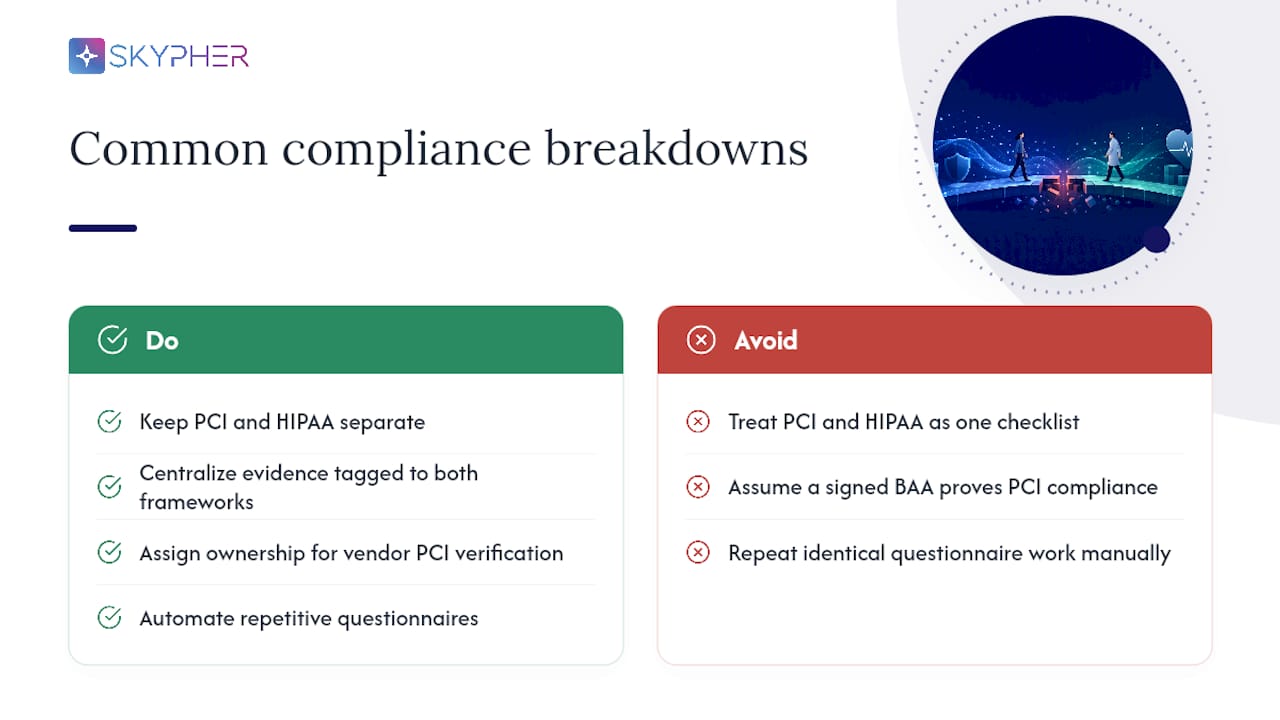
The most common pitfall is treating PCI and HIPAA as one combined checklist instead of two related but distinct programs. Teams that try to satisfy both with a single generic policy document usually end up with language too vague to pass either audit. HIPAA reviewers want specific risk-analysis reasoning; PCI assessors want specific technical evidence. A policy written to please both ends up satisfying neither.
Business associate oversight is another recurring gap. Healthcare organizations often sign a BAA and consider the vendor relationship compliant, without verifying that vendor's actual PCI posture if that same vendor touches payment data. A business associate can be fully HIPAA compliant on paper and still expose your cardholder data environment if nobody checked their PCI validation status.
Evidence fatigue is the third major pitfall, and it's largely operational rather than technical. Compliance officers juggling separate SAQ cycles, RoC preparation, HIPAA risk reviews, and an ever-growing stack of vendor security questionnaires from partners and customers often find themselves answering nearly identical questions in five different formats throughout the year. That repetition eats time that should go toward closing actual gaps.
The fix for all three pitfalls is the same: build one central evidence repository tagged against both frameworks, assign explicit ownership for business associate PCI verification, and automate the repetitive questionnaire work wherever the answers don't actually change month to month. Teams that centralize early spend far less time reconstructing the same proof points for every new auditor or customer request.
Why Documentation Discipline Beats Compliance Theater
Most organizations treat compliance as a once-a-year scramble, and that's exactly backward for standards built on continuous risk management. The teams that handle PCI and HIPAA well aren't the ones with the biggest budgets. They're the ones who wrote down their reasoning the first time, so nobody has to reconstruct it under audit pressure six months later.
What gets underestimated most is how much of the friction in dual compliance is administrative, not technical. Firewalls get configured correctly. Encryption gets implemented. What falls apart is the paper trail explaining why a specific compensating control was chosen, or which business associate actually verified their PCI status last quarter. Automation doesn't replace judgment here, but it does remove the busywork that keeps judgment from ever getting documented in the first place. A practical guide on avoiding costly PCI and HIPAA mistakes covers several of these documentation failures in more depth, and it's worth a read before your next audit cycle rather than after.
— Gaspard
Speeding Up the Evidence Side of Dual Compliance
Mapping controls and documenting rationale is the hard part of PCI and HIPAA work, and none of that goes away with software. What does go away is the hours lost re-answering the same vendor security questionnaire in five different formats every quarter. Skypher's Questionnaire Automation Tool reads existing SAQ responses, risk-analysis documentation, and policy language, then generates draft answers for new incoming questionnaires with a confidence score attached to each one.

For teams juggling both frameworks, that means:
- Answering vendor and customer security questionnaires in a fraction of the usual time, pulling from a centralized knowledge base instead of retyping the same policy language
- Sharing a live, customizable Trust Center so partners and auditors can self-serve current attestations instead of emailing for the tenth PDF
- Connecting directly with over 40 third-party risk management platforms so evidence updates flow automatically instead of manually
Skypher doesn't replace your Report on Compliance, your ASV scans, or your HIPAA risk analysis. What it does is cut the hours your team spends re-explaining those results every time a new questionnaire lands in the inbox. If evidence collection is eating time you'd rather spend closing actual gaps, get a quote and see how the Questionnaire Automation Tool fits your workflow.
Primary Sources Worth Bookmarking
Keep these close for the next assessment cycle:
- PCI Security Standards Council document library, for the current PCI DSS version and assessor guidance
- HHS guidance on covered entities, for HIPAA applicability questions
- Healthit, for technical implementation help with ePHI protections
- Skypher's guide on HIPAA assessments, for a deeper look at running risk assessments internally
This article is general information, not a substitute for advice from a qualified lawyer. Consult a qualified legal professional about your own circumstances before acting on anything here.
Sources
- PCI Security Standards Council Standards overview
- HHS Covered entities under HIPAA
- SecurityMetrics HIPAA vs. PCI DSS Compliance
- HIPAA Journal What is PCI compliance in healthcare?
FAQ
Is PCI Protected Under HIPAA?
No. PCI DSS and HIPAA protect different data types under different authorities, and satisfying one does not automatically satisfy the other. SecurityMetrics notes only partial overlap between the two frameworks' validation points, so organizations handling both data types need separate evidence for each.
How Are HIPAA and PCI DSS Alike?
Both require a documented risk assessment, strong access controls, encryption, activity logging, and an incident response plan. The underlying security fundamentals overlap enough that a well-built access control or encryption program can serve both frameworks, even though each still requires its own distinct validation evidence.
What Is PCI DSS in Healthcare?
PCI DSS in healthcare applies whenever a hospital, clinic, or provider accepts credit or debit cards for payment, regardless of whether they primarily think of themselves as a covered entity. TechTarget notes that because payment and clinical systems are rarely fully separated, most card accepting healthcare organizations end up needing both PCI DSS and HIPAA compliance simultaneously.
What Is the Relationship Between GDPR, HIPAA, and PCI DSS?
These three operate independently and cover different jurisdictions and data types: GDPR governs personal data of EU residents broadly, HIPAA governs PHI within US healthcare, and PCI DSS governs cardholder data globally regardless of industry. An organization can fall under all three simultaneously if it processes EU patient data, US health records, and card payments, and each framework requires its own separate compliance evidence.
Can Automation Tools Help With Both PCI and HIPAA Questionnaires?
Yes, tools built for security questionnaire automation, like Skypher's Questionnaire Automation Tool, can pull from a centralized evidence library to draft responses to both PCI and HIPAA related vendor questionnaires faster. Current pricing details are available directly on Skypher's site after a brief consultation.