

TL;DR:
- Skypher is an AI-powered platform that automates security questionnaire responses for compliance teams. It answers up to 200 questions in under one minute and connects with over 40 third-party platforms, improving response speed and accuracy. The platform offers confidence scoring and citation-backed answers, enabling efficient, audit-ready security reviews in complex multi-entity organizations.
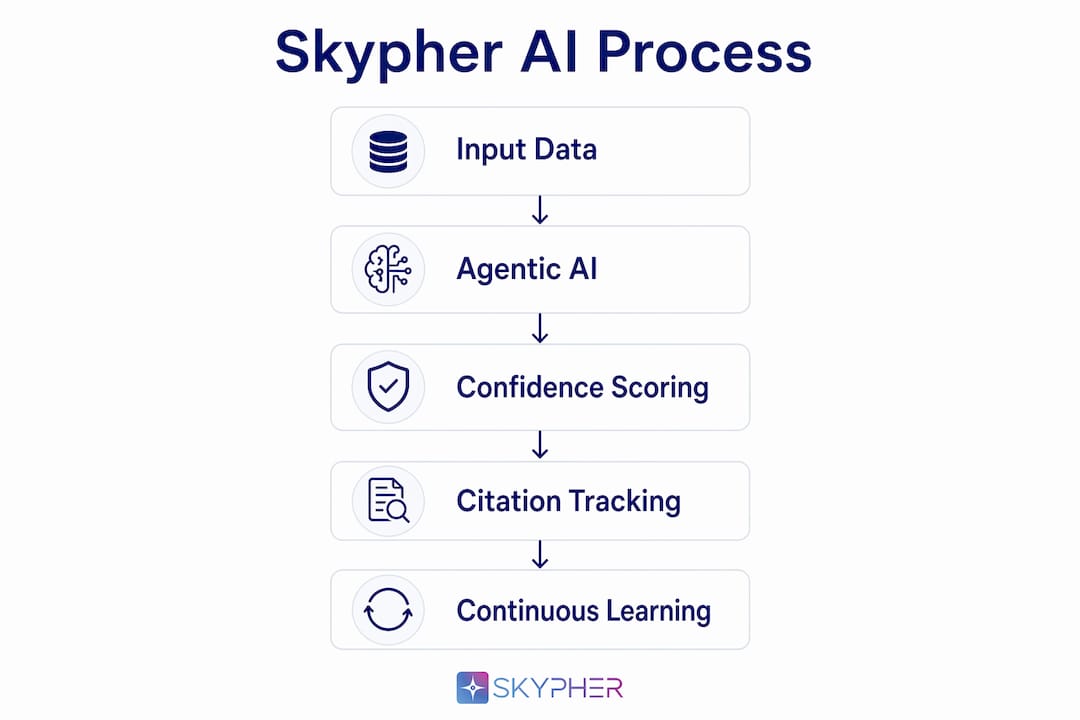
Skypher is an AI-powered agentic platform that automates security questionnaire responses for compliance and security teams in medium and large organizations. The platform can answer 200 questions in under one minute, connecting with over 40 third-party platforms including OneTrust, ServiceNow, Slack, and Microsoft Teams. For compliance professionals who spend hours manually drafting responses to vendor due diligence and third-party risk questionnaires, that speed is not a minor convenience. It is a structural shift in how security reviews get done. Skypher's core technology combines agentic AI, confidence scoring, and citation-backed answers to deliver responses that are fast, auditable, and aligned with your internal security controls.
How does Skypher's agentic AI automate questionnaire responses?
Agentic AI goes beyond simple pattern matching. It reasons autonomously over your internal security documentation, past questionnaire responses, and trust portal content to generate answers that reflect your actual security posture.

The key differentiator is Skypher's AI confidence scoring system. Every generated answer carries a confidence score powered by Skypher's own custom models. Confidence scoring lets compliance teams allocate human review time efficiently, focusing attention only where uncertainty exists. High-confidence answers move through automatically. Lower-confidence answers get flagged for expert review. That prioritization alone eliminates the bottleneck that kills most manual questionnaire workflows.
Citation-backed responses are the second pillar. Skypher provides full source tracking on every AI-generated answer, linking each response directly to the internal policy document or control that supports it. Compliance teams can verify any answer instantly without hunting through shared drives or emailing colleagues. That traceability is what separates Skypher from generic large language model tools, which produce plausible-sounding answers with no audit trail.
Pro Tip: Before you go live, map your most frequently asked questionnaire topics to specific internal documents. The more precisely your knowledge base is curated, the higher your average confidence scores will be from day one.
The AI models train on three primary sources:
- Internal security documentation uploaded by your team
- Historical questionnaire responses your organization has approved
- Trust portal content and published compliance certifications
- Structured data from connected GRC and TPRM platforms
This training loop means the system gets more accurate over time. Skypher's AI recommendation engine continuously learns organizational preferences to improve answer relevance and reduce manual review load across every subsequent questionnaire.
What integrations does Skypher offer for compliance workflows?
Skypher's integration ecosystem is one of its strongest operational advantages. The platform connects with over 40 third-party TPRM, GRC, and collaboration platforms through direct API integrations. That breadth means compliance teams rarely need to change how they work. Skypher fits into existing workflows rather than replacing them.
The collaboration integrations deserve specific attention. Skypher connects with Slack and Microsoft Teams, including chatbot support, so reviewers receive real-time notifications when answers need human validation. A questionnaire does not sit in a queue waiting for someone to log into another tool. The alert comes to where your team already works.
Document source integrations cover the full enterprise stack:
- Confluence, Notion, Google Drive, OneDrive, and SharePoint for knowledge base content
- ServiceNow for workflow automation and ticket-driven review processes
- OneTrust and other TPRM portals for direct questionnaire import and submission
- SSO protocol support for enterprise identity management
Skypher also supports diverse questionnaire formats and online portals, eliminating the manual reformatting that wastes hours when vendors send questionnaires in different structures. The platform parses every format with proprietary AI models, not generic extraction tools.
Multilingual support extends the platform's reach to global compliance teams. Organizations operating across multiple regions can process questionnaires in different languages without maintaining separate workflows or translation steps.
Pro Tip: Connect your Slack or Microsoft Teams integration before your first live questionnaire run. Notification-driven review workflows cut approval cycle times significantly compared to email-based handoffs.
Publications like Cyber Defense Magazine have noted that integration breadth is a primary adoption factor for enterprise compliance platforms. Teams that can connect a new tool to their existing stack without a long IT project are far more likely to reach full deployment.
How does Skypher handle multi-entity enterprise deployments?
Multi-entity enterprises face a problem that single-product companies never encounter. A holding company with five subsidiaries, each with distinct security controls, cannot use one monolithic knowledge base without degrading AI accuracy across all of them.
Skypher addresses this directly. The platform supports distinct knowledge bases segmented by product line, business unit, or geographic region. Each entity gets its own AI configuration, its own approved response library, and its own confidence scoring baseline. A financial services firm with separate retail banking and institutional trading divisions can maintain entirely different security postures within a single Skypher account.
Attempting to retrofit segmentation after initial deployment is costly. Monolithic knowledge bases that mix entity-specific controls produce lower confidence scores and require more manual review. The accuracy loss compounds over time as the AI trains on a blended data set that does not reflect any single entity's actual posture. Skypher users report measurably improved accuracy when knowledge bases are partitioned from day one.
Pro Tip: During your implementation kickoff, list every distinct product, subsidiary, or regulated entity in your organization. Build a separate knowledge base for each one before you upload a single document. Restructuring later is significantly harder than starting clean.
The customizable AI configurations within each entity also allow compliance leads to set different review thresholds. A high-risk regulated entity might require human review on any answer below a 90% confidence score. A lower-risk business unit might auto-approve everything above 75%. That flexibility makes Skypher practical for complex enterprise structures without forcing a one-size-fits-all policy.
What steps should compliance teams follow to implement Skypher?
A phased implementation produces better results than a full rollout on day one. The following sequence reflects how compliance teams get the most out of the platform quickly while managing risk during the transition.
-
Audit and prepare your internal documentation. Gather your security policies, control frameworks, past questionnaire responses, and compliance certifications into a single staging area. Preparation quality directly determines AI answer quality. Incomplete or outdated documents produce low-confidence answers that require manual correction.
-
Segment your knowledge bases before uploading anything. If your organization has multiple entities, products, or regulated divisions, create the knowledge base structure first. Assign document ownership to the right entity. This step prevents the accuracy problems that come from mixed data pools.
-
Connect your priority integrations. Start with the platforms your team uses daily. Slack or Microsoft Teams for notifications, ServiceNow or your TPRM platform for workflow routing, and your document repositories for ongoing knowledge base updates. Get the data flow working before you process your first questionnaire.
-
Run a phased rollout starting with high-volume questionnaires. Pick the questionnaire type your team receives most often. Run it through Skypher and compare AI-generated answers against your existing approved responses. This calibration phase reveals gaps in your knowledge base without exposing you to risk on high-stakes reviews.
-
Train your team on confidence scoring and exception workflows. Staff need to understand what a confidence score means and when to override an AI answer. The goal is not blind trust in automation. The goal is efficient allocation of expert attention to the answers that genuinely need it.
-
Monitor AI performance and refine knowledge sources over time. Skypher's AI recommendation engine learns from approved responses and corrections. Regular knowledge base updates keep the system aligned with your evolving security controls and regulatory requirements.
Key Takeaways
Skypher reduces security questionnaire response time by up to 90% through agentic AI, confidence scoring, and citation-backed answers that keep compliance teams audit-ready at scale.
| Point | Details |
|---|---|
| Agentic AI with confidence scoring | Every answer carries a score that directs human review to uncertain responses only. |
| Citation-backed source tracking | Full traceability links each AI answer to the internal document that supports it. |
| 40+ platform integrations | Connects with OneTrust, ServiceNow, Slack, Teams, and major document repositories. |
| Multi-entity knowledge base segmentation | Separate knowledge bases per entity prevent accuracy loss in complex organizations. |
| Phased implementation matters | Starting with high-volume questionnaires and clean knowledge base structure maximizes early accuracy. |
Why confidence scoring changes everything in compliance AI
Most compliance professionals I speak with share the same concern about AI-generated answers: "How do I know it's right?" That question is legitimate. Generic AI tools produce confident-sounding responses with no way to verify the source. In a compliance context, that is not a productivity tool. That is a liability.
What changed my view on AI for security questionnaires was seeing confidence scoring done properly. When a platform tells you "this answer is 94% confident, sourced from your ISO 27001 policy document, section 6.2," you are not trusting the AI blindly. You are reviewing a draft with a clear audit trail. That is a fundamentally different workflow from either manual drafting or untracked AI generation.
The integration breadth question is equally underrated. I have watched compliance teams adopt platforms that required months of IT work to connect to existing systems. Adoption stalls. The tool sits unused. The teams that succeed with automation are the ones who can plug a new platform into Slack, ServiceNow, and their document repositories in days, not quarters. That is the adoption threshold that actually matters.
The multi-entity structuring lesson is the one I wish more teams heard before they started. The temptation is to upload everything into one knowledge base and sort it out later. The cost of that decision shows up six months in, when confidence scores are lower than expected and the AI is pulling answers from the wrong entity's controls. Start segmented. Stay segmented.
— Gaspard
Skypher's platform for compliance teams ready to automate
Security questionnaire automation that cuts response time by up to 90% per review cycle is no longer a future capability. Skypher delivers it now, with agentic AI, full source tracking, and over 40 platform integrations built for enterprise compliance environments.

Skypher's Trust Center platform gives your team a single place to manage and share your security and compliance posture with prospects, clients, and auditors. The AI recommendation engine refines answer quality with every questionnaire your team processes. Whether you are managing one compliance program or five distinct entities, Skypher scales to the structure of your organization. Request a demo to see the platform in action with your own questionnaire formats and knowledge base.
FAQ
What is Skypher used for?
Skypher automates responses to vendor security questionnaires and due diligence reviews using agentic AI. It is designed for compliance and security teams in medium and large organizations that handle high volumes of security reviews.
How fast can Skypher answer security questionnaires?
Skypher's AI can process and answer up to 200 security questions in under one minute. That speed applies across supported questionnaire formats and connected portals.
How does Skypher's confidence scoring work?
Each AI-generated answer receives a confidence score based on Skypher's proprietary models. Compliance teams use these scores to identify which answers need human review and which can be approved automatically.
What platforms does Skypher integrate with?
Skypher connects with over 40 third-party platforms including OneTrust, ServiceNow, Slack, Microsoft Teams, Confluence, Notion, Google Drive, OneDrive, and SharePoint. SSO protocol support is also included for enterprise identity management.
Does Skypher support multi-entity organizations?
Skypher supports distinct knowledge bases segmented by product line, business unit, or geographic region. Each entity gets its own AI configuration and response library, which preserves accuracy across complex enterprise structures.