

An AI-driven questionnaire automation platform that pairs a version-controlled knowledge base with SME approval workflows is the fastest way for vendor-risk and compliance teams to scale security reviews without sacrificing accuracy. You can expect 70–80% reduction in SME time on routine questionnaires and consistent, citation-backed answers across every submission. The practical next step: run a two-week pilot on three to five low-stakes vendor deals, measure accuracy and SME hours, and use those results to build your internal business case.
Key Takeaways
AI-driven questionnaire automation with source citations and SME approval workflows is the most reliable way to scale vendor security reviews without increasing headcount.
| Point | Details |
|---|---|
| Tier vendors before automating | Apply critical/high/medium/low tiers so SMEs focus on high-risk vendors, not routine ones. |
| Require source citations | Every AI-generated answer must link to its source document to prevent hallucination reaching customers. |
| Pilot before scaling | Run two weeks on low-stakes deals; target 70–80% SME-hour reduction as your success benchmark. |
| Validate the tool's own security | Confirm SOC 2 certification, data residency, RBAC, and immutable audit logs before signing. |
| Skypher as your pilot platform | Skypher's 40+ integrations, Trust Center, and sub-minute answer generation cover the full enterprise checklist. |
Table of Contents
- What do tools for automating security reviews actually do?
- Which features should you require from a questionnaire-automation tool?
- How do you implement questionnaire automation at enterprise scale?
- What does questionnaire automation cost, and when does it pay off?
- What security checks must the automation tool itself pass?
- How do you run a demo and select the right vendor?
- A candid view on where most automation projects go wrong
- Skypher covers the checklist, and a pilot takes two weeks
- Sources
What do tools for automating security reviews actually do?
These platforms solve one specific problem: the manual, repetitive work of answering third-party security questionnaires at scale. They are not vulnerability scanners, code-review tools, or SOAR platforms. Understanding that boundary is what separates a successful deployment from a misaligned one.
Here is what a modern questionnaire-automation platform covers:
-
Auto-response generation from an approved, version-controlled knowledge base, with each answer linked to its source document (SOC 2 report, ISO certificate, internal policy)
-
Multi-format ingestion of Excel, PDF, and web-form questionnaires, parsed and mapped to your existing answer library
-
Evidence attachment and storage, pulling certificates and policy documents automatically from SharePoint, Google Drive, OneDrive, or Confluence
-
Audit trails recording who drafted, edited, and approved every answer, and when
-
SME routing via Slack or MS Teams when a question falls below the confidence threshold or is flagged as high-risk
-
Trust Center maintenance, giving customers self-serve access to your current certifications and security posture
A typical workflow runs like this:
- Questionnaire arrives (email, portal, or direct upload)
- Platform parses and maps each question to the knowledge base
- AI drafts answers with source citations attached
- Low-confidence or high-risk answers route to named SMEs via Slack or MS Teams
- Reviewer approves, edits, or escalates
- Final response exports to the target TPRM portal or XLS and archives in the Trust Center
What these tools do not do: they do not replace SME judgment on high-risk items, perform penetration testing, or scan code for vulnerabilities. Pairing automation with external security ratings and continuous monitoring produces better assurance than questionnaires alone.
Which features should you require from a questionnaire-automation tool?
Not all platforms are built for enterprise scale. Below is a prioritized checklist, ordered by the impact each feature has on security, auditability, and throughput.
Tier 1: Security and auditability (non-negotiable)
- Version-controlled knowledge base with source citations on every AI-generated answer
- Configurable SME approval workflows with named reviewer assignments
- Confidence scoring that routes answers below a set threshold to human review
- Immutable audit logs capturing every edit, approval, and evidence link
- Role-based access controls (RBAC) and SSO via SAML/SCIM
Tier 2: Integration coverage
- Connectors to TPRM platforms (OneTrust, ServiceNow, and 30+ others)
- Slack and MS Teams integrations, including chatbot-style SME routing
- Document store connectors: SharePoint, Google Drive, OneDrive, Confluence, Notion
- API access for custom automation and CRM triggers
Tier 3: Usability and governance
- Editable answer templates mapped to SOC 2, ISO 27001, NIST, and Shared Assessments SIG frameworks
- Evidence linking to live certificates and policy documents
- Customer-configurable retention and archiving policies
- Multilingual support for global vendor portfolios
| Feature category | Priority | Why it matters |
|---|---|---|
| Source citations on AI answers | Critical | Prevents hallucination from reaching customers |
| Confidence-threshold routing | Critical | Keeps SMEs focused on genuinely uncertain answers |
| Immutable audit trail | Critical | Required for SOC 2 and regulatory audits |
| TPRM platform connectors | High | Eliminates manual copy-paste into portals |
| SSO / SCIM provisioning | High | Enterprise access governance requirement |
| Framework-mapped templates | Medium | Speeds answer reuse across SOC 2 / ISO / NIST |
For a deeper look at security questionnaire best practices that align with these tiers, the Skypher blog covers version control and evidence management in detail.
How do you implement questionnaire automation at enterprise scale?
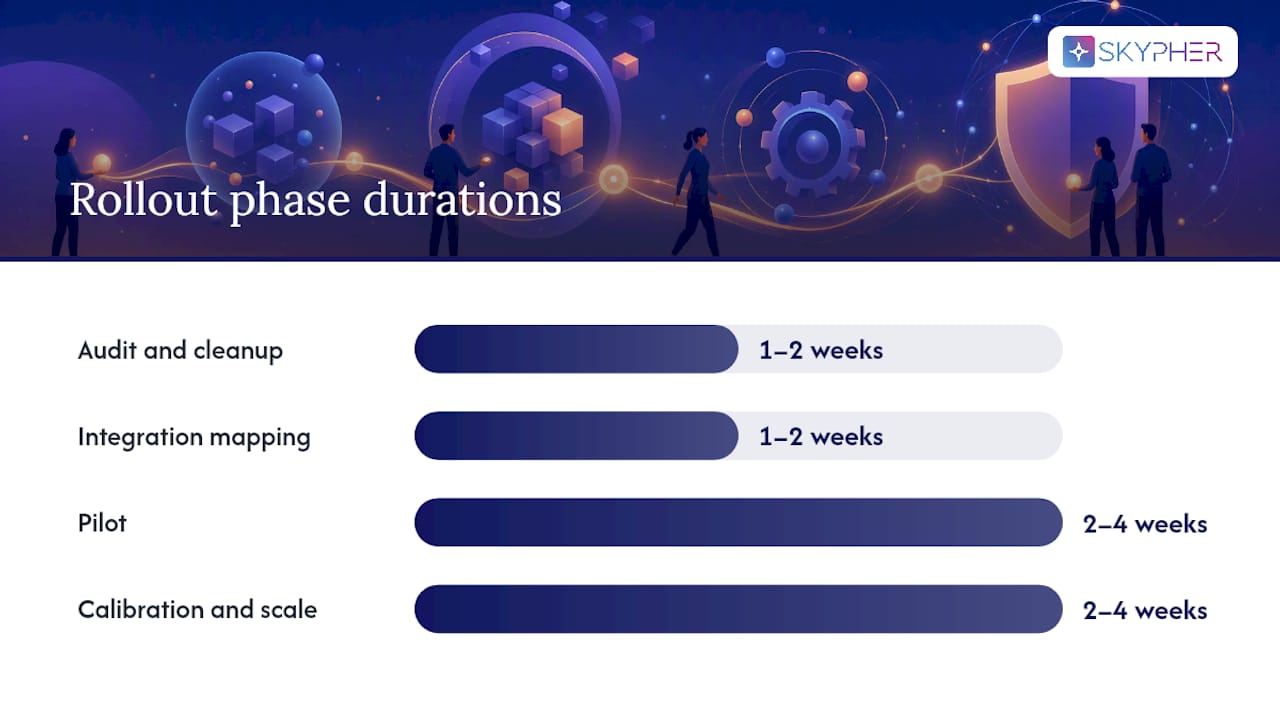
A phased rollout protects accuracy and builds internal confidence. Here are the four phases we recommend:
- Audit and clean the knowledge base (weeks 1–2): Collect all approved policies, past questionnaire responses, SOC 2 reports, ISO certificates, and pentest summaries. Remove outdated answers and tag each document with its framework mapping.
- Map integrations (weeks 2–3): Confirm SSO configuration, connect document stores, and identify which TPRM portals need direct connectors. Define vendor tiering rules (critical / high / medium / low) using risk-based criteria from ISACA so high-tier vendors receive detailed questionnaires and manual verification.
- Run the pilot (weeks 3–6): Select three to five low-stakes deals. Configure confidence thresholds conservatively, assign named reviewers, and track weekly accuracy and SME-hour metrics.
- Calibrate and scale (weeks 6–10): Tune thresholds based on live data, build approval workflow templates, configure automated reassessment triggers, and set operational SLAs for review and escalation.
| Phase | Duration | Key output |
|---|---|---|
| Audit and cleanup | 1–2 weeks | Clean, tagged knowledge base |
| Integration mapping | 1–2 weeks | Connected TPRM portals and document stores |
| Pilot | 2–4 weeks | Accuracy baseline and SME-hour benchmark |
| Calibration and scale | 2–4 weeks | Tuned thresholds and full workflow templates |
Pro Tip: Set confidence thresholds conservatively in week one, then tune them downward only after two full weeks of live data. Starting too permissive means low-quality answers reach customers before you have a feedback loop to catch them.
Risk-based tiering templates which separate critical suppliers from low-risk vendors are the single biggest lever for keeping SME time focused where it counts. Teams that skip this step consistently report wasted senior-reviewer hours on vendors who warranted a two-question contract clause, not a 200-question SIG.
What does questionnaire automation cost, and when does it pay off?
Pricing typically follows one of three models: per-seat subscription, per-assessment volume, or enterprise flat fee. For large portfolios (50+ active vendor assessments per quarter), enterprise flat-fee contracts scale better because per-assessment costs compound quickly at volume.
ROI benchmarks worth tracking:
- SME hours per questionnaire: baseline before the pilot, then measure weekly. Vendor-reported data from AI-driven platforms suggests 70–80% reductions on routine questionnaires.
- Time-to-complete: from questionnaire receipt to submission. Platforms capable of drafting answers to 200 questions in under one minute compress a multi-day process to hours.
- Escalation rate: the percentage of questions routed to SMEs. A well-tuned system targets below 20% escalation on standard frameworks.
- Answer acceptance rate: the percentage of AI-drafted answers approved without edits. Track this weekly during the pilot.
- Sales cycle impact: measure time-to-close on deals where security sign-off was a blocker before and after automation.
Add the sales-cycle acceleration value for deals delayed by security reviews. Most enterprise teams reach payback within one to two quarters. See why security questionnaires matter for a fuller breakdown of these metrics.
What security checks must the automation tool itself pass?
Before you trust a platform with your questionnaire responses and evidence documents, validate these controls:
- Data residency and encryption: confirm data is stored in your required region (US-based for most finance and regulated-tech teams) and encrypted at rest and in transit
- SOC 2 Type II or ISO 27001 certification for the vendor itself
- RBAC and SSO: least-privilege role assignments and SAML/SCIM provisioning
- Least-privilege API keys: scoped tokens, not broad admin credentials
- Customer-configurable retention policies: you control how long data is stored and when it is purged
For auditability, require:
- Source citations on every AI-generated answer, traceable to the specific document and section
- Reasoning traces or confidence scores visible to reviewers
- Immutable audit logs for every evidence link and approval action
Operationally, name a reviewer for every questionnaire, set confidence thresholds that force SME review on high-risk questions, and schedule quarterly knowledge-base audits to retire stale answers. Build a feedback loop so rejected or edited answers update the knowledge base automatically.
When you send an RFP to a questionnaire-automation vendor, include these same controls as evaluation criteria. A vendor who cannot answer their own security questionnaire with source citations is a meaningful signal.
How do you run a demo and select the right vendor?
Use this script in every live demo to test real enterprise readiness:
- Upload a real questionnaire sample (your most complex recent format) and watch the ingestion and parsing
- Confirm evidence auto-attach pulls from your actual document store (SharePoint or Google Drive)
- Ask the vendor to show citation provenance on three AI-generated answers
- Trigger a low-confidence routing scenario and verify the Slack or MS Teams notification
- Export the completed questionnaire to your target TPRM portal or XLS
RFP questions to include:
- Full integration list: SSO protocols, TPRM connectors, CRM hooks, and document stores
- Uptime SLA and support model (24/7 enterprise support vs. business-hours only)
- Documented accuracy metrics from production deployments
- API capabilities and rate limits
- Data residency options and certification status
Score vendors on five axes, weighted for your stakeholder mix:
After the demo, run a two-week trial with real questionnaires. Measure accuracy, SME-review hours, and change-request volume. Ask for a migration plan for your existing response library before signing. The compliance admin workflow guide on the Skypher blog covers operational setup in more detail.
A candid view on where most automation projects go wrong
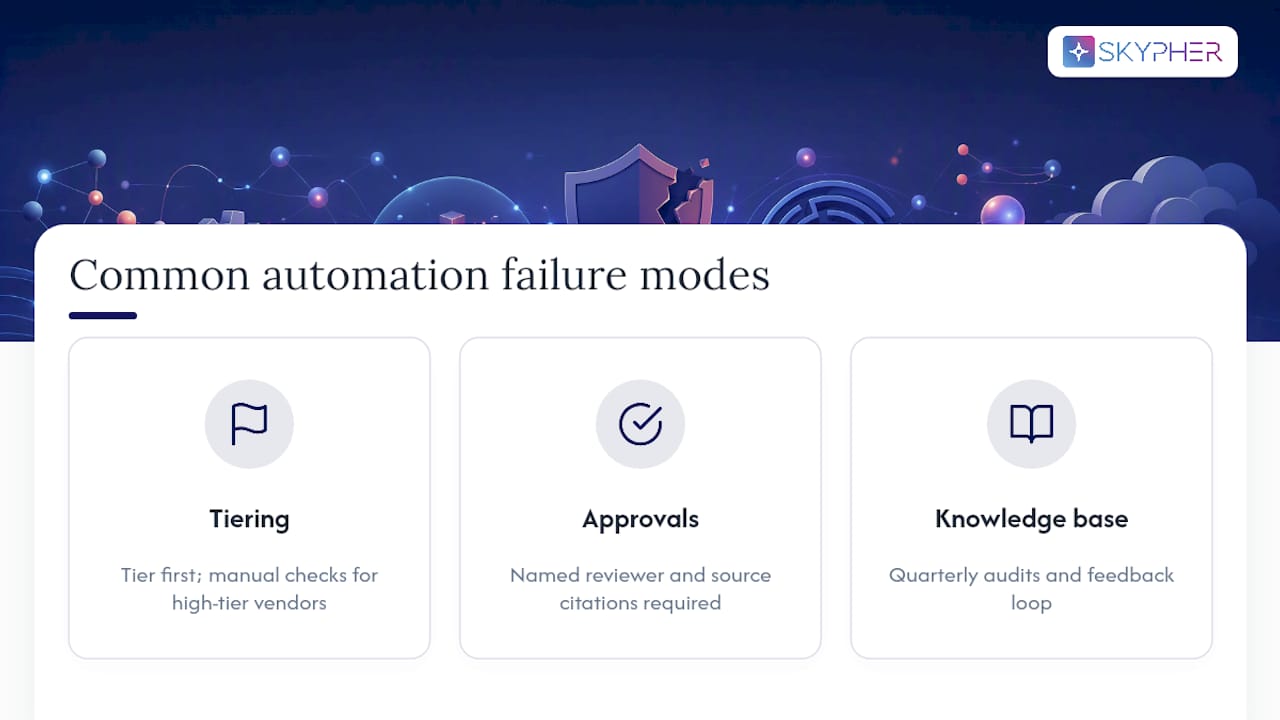
The three failure modes we see most often are not technical. They are process failures.
The first is skipping tiering. Teams automate everything and then wonder why senior security engineers are spending hours on a SaaS tool that processes $5,000 in annual spend. ISACA's guidance is direct on this: tier first, automate second. High-tier vendors need manual verification, audit reports, and sometimes on-site reviews. Automation handles the volume below that threshold.
The second is weak approval workflows. Automation without named reviewers and confidence-threshold routing is just fast hallucination delivery. Require source citations on every AI answer and assign a named reviewer to every questionnaire. Accountability is what separates a defensible process from a liability.
The third is ignoring knowledge-base hygiene. A knowledge base built on two-year-old policy documents and deprecated SOC 2 reports will produce confidently wrong answers. Schedule quarterly audits and build a feedback loop so edited answers propagate back to the source.
Skypher covers the checklist, and a pilot takes two weeks
Skypher maps directly to the must-have features covered in this article: a version-controlled knowledge base with source citations on every answer, over 40 TPRM platform integrations, SSO via SAML/SCIM, a customizable Trust Center for customer-facing security posture, and immutable audit trails. The AI-powered recommendation engine drafts answers to 200 questions in under one minute, routes low-confidence items to named SMEs via Slack or MS Teams, and supports complex enterprise setups with multiple products or entities.

A typical Skypher pilot runs two weeks on three to five live questionnaires. You measure accuracy rate, SME hours saved, and time-to-complete against your current baseline. Those numbers become your internal business case. If you are ready to run that pilot, start your evaluation here and our team will configure your knowledge base and integrations from day one.
Sources
Use these references when building your RFP, pilot plan, or internal business case:
- ISACA
- Value Governance Research — Vendor security questionnaire best practices and risk‑based due diligence
When you run your pilot, bring the NIST and SIG frameworks into your knowledge-base configuration from the start. Mapping answers to named frameworks at ingestion time saves significant rework when customers ask for framework-specific evidence later.