

TL;DR:
- Vanta automates continuous compliance monitoring for frameworks like SOC 2, HIPAA, and GDPR, reducing manual effort. However, its SOC 2 Type II certification is vendor-attested and requires procurement teams to verify through full audit reports. Organizations should conduct independent risk assessments and request signed DPAs before fully relying on Vanta's automated evidence.
Vanta security is a trust management platform that automates compliance monitoring across frameworks including SOC 2, HIPAA, ISO 27001, PCI, and GDPR. For compliance and security teams in medium to large organizations, that means replacing manual evidence collection with continuous, automated workflows. The platform continuously monitors controls, flags gaps, and generates audit-ready documentation. Understanding what Vanta automates, what it does not verify independently, and how to conduct proper vendor due diligence on Vanta itself gives your team a complete picture before committing to the platform.
How does Vanta security work for compliance automation?
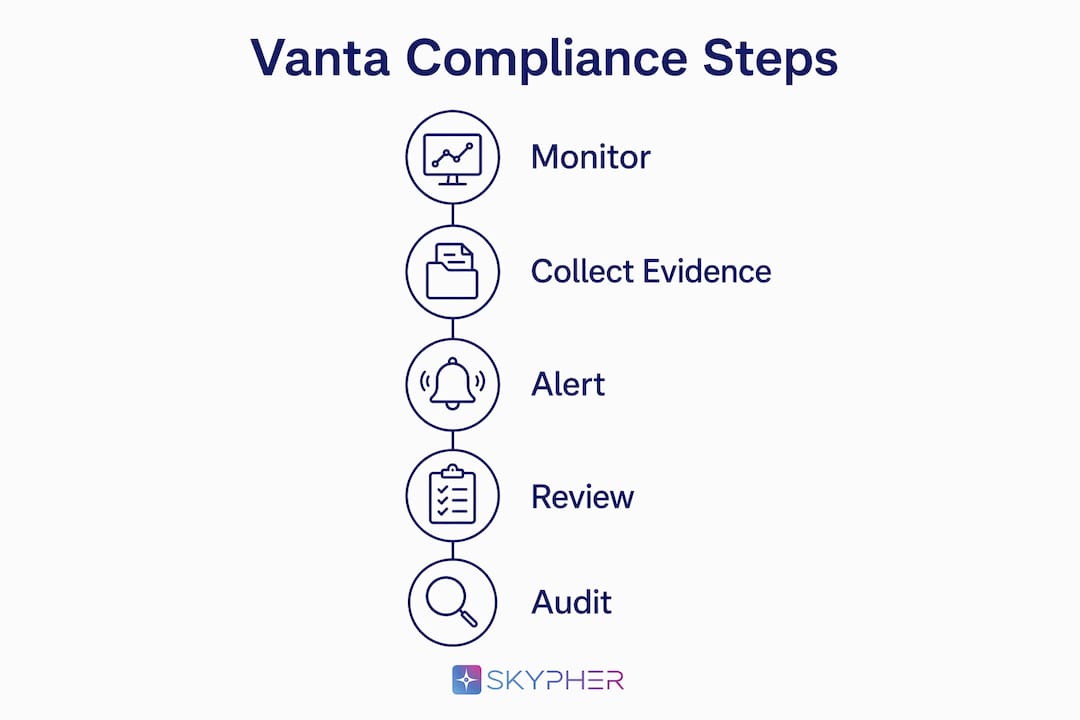
Vanta security operates through continuous control monitoring and automated evidence collection. Rather than waiting for an annual audit cycle, the platform checks your environment in real time and maps findings to specific compliance requirements.

Core monitoring and evidence collection
The Vanta Agent monitors device configurations across your organization's endpoints. It checks encryption status and password managers without transmitting sensitive personal data, environment variables, or stored passwords. That distinction matters for privacy-conscious teams: Vanta collects configuration metadata, not content.
Vanta integrates directly with cloud infrastructure providers and SaaS tools your organization already uses. When a control falls out of compliance, the platform generates an alert and links it to the relevant framework requirement. This closes the gap between detection and remediation that manual processes leave open.
Supported compliance frameworks include SOC 2, HIPAA, ISO 27001, PCI DSS, and GDPR. Each framework maps to a set of automated checks, so your team sees which controls pass, which fail, and which require manual evidence uploads. The result is a live compliance dashboard rather than a static spreadsheet.
- Continuous monitoring replaces point-in-time manual checks
- Automated evidence collection reduces audit preparation time
- Framework-specific control mapping shows gaps in real time
- Cloud and SaaS integrations pull data without manual exports
- Device monitoring covers encryption, screen lock, and security software status
Pro Tip: Configure Vanta's alert thresholds to notify your security team within 24 hours of a control failure. Catching drift early prevents a single misconfiguration from becoming an audit finding.
What certifications does Vanta claim, and how do you verify them?
Vanta claims SOC 2 Type II certification, which is the gold standard for SaaS security assurance. The critical detail for procurement teams is that Vanta's SOC 2 Type II claim is vendor-attested. No public registry listing exists to independently confirm it.
Understanding vendor-attested certifications
Vendor-attested means the organization self-reports the certification without a publicly accessible third-party registry entry. This is not uncommon in the SaaS industry, but it does shift verification responsibility to your procurement team. You cannot simply search a public database and confirm the certificate.
The practical implication is straightforward. Your team must request the full audit report directly from Vanta, confirm the auditor's name and credentials, and verify the audit review period. A SOC 2 Type II report covers a minimum of six months of operational history. If the report Vanta provides covers a shorter period or lists an auditor you cannot verify, treat that as a red flag.
PCI-DSS 4.0 Requirement 12.8 mandates rigorous third-party risk assessments for any SaaS vendor handling cardholder data. That requirement includes independent verification of compliance certifications and signed Data Processing Agreements. Even if your organization is not subject to PCI DSS, the framework provides a useful procurement standard to apply broadly.
| Certification type | Verification method | Key question to ask |
|---|---|---|
| Vendor-attested SOC 2 Type II | Request full audit report from vendor | Who is the auditor, and what is the review period? |
| Independently listed SOC 2 Type II | Search AICPA or auditor's public registry | Does the listing match the vendor's claims? |
| ISO 27001 | Request certificate from accredited body | Is the certifying body accredited by IAF? |
| HIPAA attestation | Request BAA and third-party assessment | Has a qualified assessor reviewed the controls? |
Pro Tip: Ask Vanta's sales team for the auditor's firm name before signing a contract. A reputable auditor with a verifiable public profile adds credibility that a vendor-attested claim alone cannot provide.
What does independent risk assessment say about Vanta?
The ThirdProof 2026 Vendor Risk Report assigned Vanta a moderate risk tier. That rating reflects specific technical and historical factors, not a general judgment on the platform's compliance automation quality.
Key risk factors from the ThirdProof report
Two findings drove the moderate rating. First, Vanta's infrastructure includes an IP address flagged with a 52% abuse confidence score. Second, a publicly documented bug previously exposed customer data. Neither finding disqualifies Vanta as a vendor, but both require your team to ask direct questions and document the answers.
The ThirdProof report also notes that no public references exist for Vanta's certificates. That finding aligns with the vendor-attested status of the SOC 2 Type II claim. For a platform that sells compliance automation, the absence of publicly verifiable certification creates an irony your procurement team should address directly.
Risk tier implications for medium to large enterprises are concrete. A moderate risk rating typically triggers additional due diligence steps under most enterprise procurement policies. Your team should treat Vanta as a Tier 2 vendor at minimum, which means annual reassessment, signed DPAs, and documented incident response expectations.
Key risk factors and recommended procurement steps:
- Confirm current IP reputation status with your security team before deployment
- Request documentation of the data exposure incident and remediation steps taken
- Obtain a signed Data Processing Agreement before any data flows to Vanta
- Schedule annual vendor reassessment aligned with Vanta's SOC 2 audit cycle
- Document all verification steps in your vendor risk register
Best practices for integrating Vanta into your compliance workflows
Combining automated compliance tools with traditional audit and vendor review processes produces the best outcomes. Vanta's automation handles the high-volume, repetitive work. Your team handles judgment calls and verification.
A structured integration approach
Follow these steps to integrate Vanta without creating gaps in your risk management program:
- Conduct a third-party risk assessment on Vanta itself. Use an automated vendor risk platform to generate an initial profile, then supplement it with manual verification of certifications, DPAs, and incident history. Do not skip this step because Vanta is a compliance tool.
- Align your internal audit team with Vanta's outputs. Vanta generates evidence automatically, but your auditors need to understand what the platform collects and what it does not. Map Vanta's automated evidence to your audit program's evidence requirements before your first audit cycle.
- Review and sign a Data Processing Agreement. Obtaining a signed DPA from Vanta is a non-negotiable procurement step. The DPA defines how Vanta processes your organization's data, retention periods, and breach notification timelines.
- Set a monitoring cadence for Vanta's own performance. Review Vanta's compliance status quarterly. Check whether the platform's own certifications have been renewed and whether any new security incidents have been disclosed.
- Use Vanta's real-time dashboard to support sales and procurement conversations. Vanta's Trust Center features let your team share compliance posture with customers and partners. That visibility reduces the time your team spends answering repetitive security questionnaires.
Pro Tip: Never treat a green status in Vanta's dashboard as a substitute for your own audit review. Automated tools flag known control failures. They do not catch control gaps that were never configured in the first place.
The security monitoring and automation that Vanta provides works best when your team treats it as an input to your compliance program, not the program itself. Automation raises the floor. Skilled compliance professionals raise the ceiling.
Key Takeaways
Vanta security automates compliance evidence collection across SOC 2, HIPAA, ISO 27001, PCI, and GDPR, but vendor-attested certifications require active procurement verification to meet enterprise risk standards.
| Point | Details |
|---|---|
| Automation scope | Vanta monitors controls and collects evidence continuously, replacing manual audit prep cycles. |
| Certification verification | Vanta's SOC 2 Type II is vendor-attested; request the full audit report and auditor credentials directly. |
| Independent risk rating | ThirdProof assigned Vanta a moderate risk tier based on IP reputation and a past data exposure incident. |
| DPA requirement | Obtain a signed Data Processing Agreement from Vanta before any organizational data flows to the platform. |
| Integration best practice | Treat Vanta's outputs as inputs to your audit program, not as a replacement for independent review. |
Vanta's role in 2026 compliance programs: a frank assessment
Vanta delivers real value. The continuous monitoring model genuinely reduces the manual burden on compliance teams, and the framework-specific control mapping is well-designed for organizations preparing for SOC 2 audits. I have seen teams cut their audit preparation time significantly by centralizing evidence collection through a platform like Vanta rather than chasing spreadsheets across departments.
That said, the vendor-attested certification issue is not a minor footnote. A platform that sells compliance credibility to its customers should hold itself to the same verification standard it helps those customers achieve. The absence of a publicly verifiable SOC 2 listing is a gap that Vanta's procurement and legal teams should close, not one that your team should quietly accept.
The moderate risk rating from ThirdProof does not mean Vanta is unsafe. It means your team has specific questions to ask and specific documentation to collect. That is exactly the kind of nuance that separates a mature compliance program from one that rubber-stamps vendor claims because the vendor's marketing language sounds authoritative.
My practical advice: use Vanta for what it does well, which is automating the high-volume evidence collection work that consumes compliance team hours. Pair it with a rigorous vendor risk assessment process that treats Vanta the same way you would treat any other SaaS vendor handling sensitive organizational data. The organizations that get this balance right will have both efficient compliance programs and defensible procurement records.
— Gaspard
How Skypher's Trust Center fits alongside Vanta
Vanta handles continuous control monitoring well. Where many compliance teams still lose hours is in responding to the security questionnaires that customers and partners send after reviewing your compliance posture.

Skypher's Trust Center Platform gives your organization a single, shareable view of your security and compliance posture, reducing the back-and-forth that follows every audit or vendor review. Skypher's AI-powered questionnaire automation answers even complex security questionnaires in under a minute, pulling from your existing documentation and compliance evidence. With integrations across Slack, Microsoft Teams, Confluence, and over 40 third-party risk management platforms, Skypher fits directly into the workflows your team already uses. For compliance teams running Vanta alongside a broader security program, Skypher closes the questionnaire gap that automated monitoring alone cannot fill.
FAQ
What is Vanta security used for?
Vanta security automates compliance monitoring and evidence collection for frameworks including SOC 2, HIPAA, ISO 27001, PCI DSS, and GDPR. Organizations use it to reduce manual audit preparation work and maintain continuous visibility into their security controls.
How does Vanta monitor devices?
Vanta's Agent checks device configurations such as encryption status, screen lock settings, and the presence of security software. It collects configuration metadata only and does not transmit sensitive personal data, environment variables, or passwords.
Is Vanta's SOC 2 Type II certification independently verified?
Vanta's SOC 2 Type II claim is vendor-attested, meaning no public registry listing exists to confirm it independently. Procurement teams should request the full audit report, auditor name, and review period directly from Vanta before signing contracts.
What risk rating has Vanta received from independent assessors?
The ThirdProof 2026 Vendor Risk Report assigned Vanta a moderate risk tier, citing a 52% abuse confidence IP address score and a past customer data exposure incident. Organizations should conduct their own vendor risk assessment and obtain a signed Data Processing Agreement.
Does Vanta replace a full third-party risk assessment?
Vanta does not replace a third-party risk assessment. Automation aids efficiency but does not substitute for independent verification of certifications, DPA review, and documented procurement due diligence required under standards like PCI-DSS 4.0 Requirement 12.8.