

TL;DR:
- Vendor cybersecurity involves ongoing assessment and management of third-party risks to protect organizational data. Continuous monitoring and AI automation enhance efficiency, accuracy, and focus on critical vendors, enabling better risk control. Effective programs rely on risk tiering, standardized frameworks, and collaborative relationships to prevent breaches and improve security outcomes.
Vendor cybersecurity is the practice of assessing, monitoring, and mitigating risks that third-party vendors introduce to your organization's security posture. The industry term for this discipline is Third-Party Risk Management, or TPRM. Most breaches today trace back not to direct attacks but to trusted vendors with privileged access to internal systems and data. Frameworks like ISO 27001, NIST, and the Standardized Information Gathering (SIG) questionnaire exist precisely because vendor risk is both measurable and manageable. The organizations that treat vendor cybersecurity as a continuous program rather than an annual checkbox consistently outperform those that do not.
What is vendor cybersecurity risk assessment?
Vendor risk assessment is the structured process of evaluating each vendor's security controls, compliance posture, and operational stability before and after onboarding. A vendor risk assessment covers four core dimensions: security controls, regulatory compliance, operational resilience, and ongoing monitoring adherence. Skipping any one of these dimensions leaves a blind spot that attackers routinely exploit.
How to tier vendors by risk level
Not every vendor deserves the same level of scrutiny. Tiering vendors by data access sensitivity, system access level, and business criticality is the foundation of any sustainable program. Fewer than 15% of vendors typically qualify as critical risk, which means the vast majority of your vendor population can be assessed with lighter-touch methods.
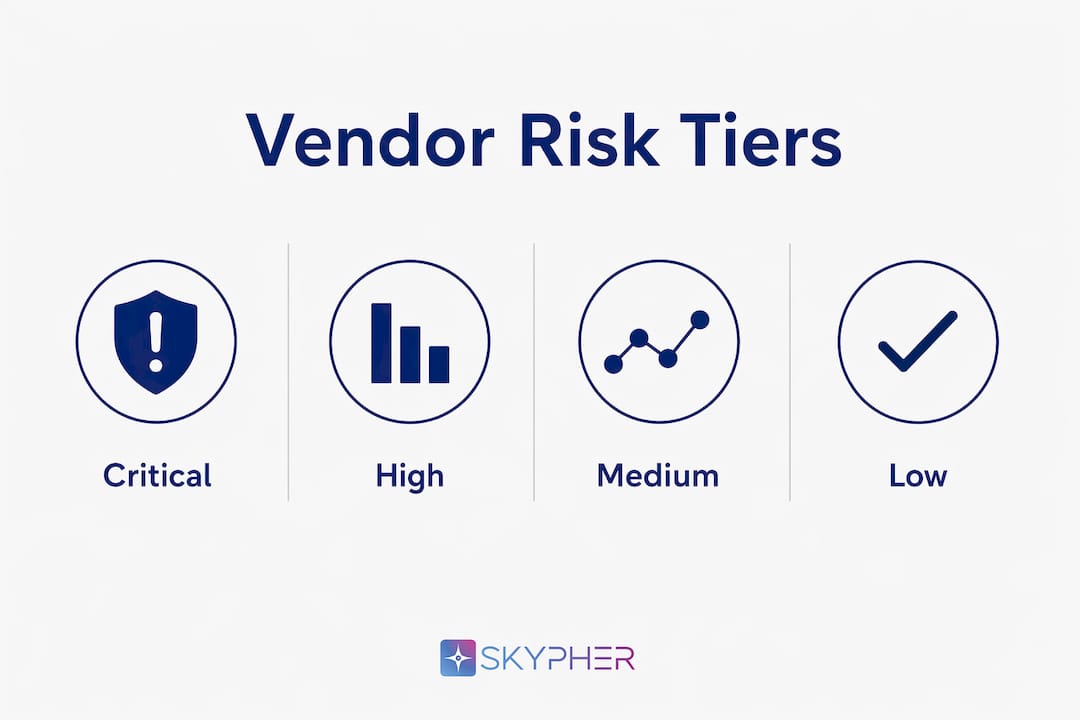
The practical benefit of tiering is resource focus. Your security team has finite capacity. Applying full due diligence to every vendor burns out analysts and produces lower-quality assessments across the board. Concentrating rigorous reviews on that critical 15% produces better outcomes with less effort.
A working tier structure looks like this:
- Critical vendors: Direct access to sensitive data or core infrastructure. Full security questionnaire, SOC 2 Type II review, penetration test evidence, and annual reassessment.
- Medium-risk vendors: Indirect data access or limited system integration. Abbreviated questionnaire and reassessment every one to two years.
- Low-risk vendors: No data access, commodity services. Lightweight intake form and reassessment at contract renewal or every two to three years.
Pro Tip: Map each vendor to a tier during onboarding, not after an incident. Retroactive tiering is slower and often incomplete because contract terms have already been set.
| Tier | Access profile | Assessment depth | Reassessment cycle |
|---|---|---|---|
| Critical | Sensitive data or core systems | Full questionnaire plus evidence review | Annual |
| Medium | Indirect or limited access | Abbreviated questionnaire | Every 1–2 years |
| Low | No data access | Lightweight intake form | Every 2–3 years or at renewal |
What are the best practices for vendor security management?
The strongest vendor security programs share three characteristics: they use recognized frameworks, they reassess on defined cycles, and they monitor continuously between those cycles.

ISO 27001, NIST SP 800-161 (Supply Chain Risk Management), and the SIG questionnaire are the three frameworks most widely adopted by tech and finance organizations. ISO 27001 provides a certifiable management system. NIST SP 800-161 maps supply chain controls to federal risk standards. SIG standardizes the questions you ask vendors, which matters because questionnaire fatigue produces boilerplate answers that tell you nothing useful. Standardized frameworks reduce that fatigue and improve the quality of data you receive.
Reassessment cycles should follow the tier structure. Standard TPRM benchmarks call for annual reviews of critical vendors, every one to two years for medium-risk vendors, and every two to three years for low-risk vendors. These cycles assume continuous monitoring fills the gaps between formal reviews.
Continuous monitoring is the part most programs underinvest in. Point-in-time assessments are obsolete as a standalone method. A vendor that passes an annual review in january can suffer a breach in march. Automated external risk signals, including dark web monitoring, vulnerability feeds, and security ratings, provide the real-time visibility that periodic questionnaires cannot.
Pro Tip: Connect your compliance frameworks to your vendor tier criteria. A vendor that holds an active ISO 27001 certification can often move to a lighter assessment track for medium-risk activities, freeing your team for higher-priority reviews.
Key practices that separate mature programs from basic ones:
- Require evidence, not assertions. A vendor saying "we are working on SOC 2" is not the same as providing a completed SOC 2 Type II report.
- Automate reassessment triggers. Contract renewals, ownership changes, and breach disclosures should automatically queue a reassessment.
- Track remediation, not just findings. An open finding with no remediation timeline is an unmanaged risk.
How does AI improve vendor cybersecurity programs?
AI-powered automation addresses the two biggest failure modes in vendor risk programs: inconsistency and speed. Manual assessments vary by analyst, by quarter, and by workload. Automated workflows apply the same criteria every time, which makes your risk data comparable across vendors and over time.
The efficiency gains are significant. Automating onboarding and reassessments with AI-powered tools can cut time-to-assessment by up to 75% compared to manual methods. That is not a marginal improvement. It means a program that previously took four weeks per critical vendor can complete the same review in under one week.
The downstream financial impact is also measurable. Autonomous TPRM programs reduce assessment and reporting time by 73%, cut mean time to remediate (MTTR) by 40%, and save up to 20% on cyber insurance premiums. Insurers price premiums based on demonstrated risk management maturity. A documented, automated program with continuous monitoring is a concrete signal of that maturity.
Specific capabilities that AI brings to vendor risk programs:
- Automated questionnaire completion: AI reads vendor-submitted responses, maps them to your control framework, and flags gaps without manual review.
- Continuous risk scoring: External signals update vendor risk scores in real time rather than waiting for the next scheduled assessment.
- Evidence extraction: AI parses SOC 2 reports, penetration test summaries, and policy documents to verify control claims automatically.
- Multilingual support: For global vendor portfolios, AI handles questionnaires in multiple languages without requiring separate analyst teams.
Skypher's AI-powered recommendation engine applies these capabilities directly to security questionnaire workflows, enabling teams to complete reviews significantly faster while maintaining accuracy. The platform integrates with over 40 TPRM platforms and connects to tools like Slack, ServiceNow, Confluence, and SharePoint, which means your vendor risk data lives inside the systems your team already uses.
How do collaborative vendor relationships improve security outcomes?
The adversarial model of vendor security, where you send a questionnaire and wait for a vendor to comply, produces worse security outcomes than a collaborative approach. Collaborative vendor risk management creates transparency and allows security issues to surface before they escalate into incidents.
The practical difference is in how remediation works. In an adversarial model, a vendor with a failing control has no incentive to disclose it early. In a collaborative model, where you have established a working relationship with the vendor's security team, that vendor is more likely to flag an issue proactively and work with you on a remediation timeline. That early disclosure is what prevents a vendor gap from becoming a breach.
Building collaborative relationships requires a few deliberate choices:
- Share your security expectations before the contract is signed, not after the first assessment.
- Assign a named point of contact on your side for each critical vendor's security team.
- Treat remediation conversations as problem-solving sessions, not compliance enforcement.
- Use standardized vendor management practices to reduce the administrative burden on vendor security teams, which makes them more willing to engage.
Questionnaire fatigue is a real barrier to collaboration. When vendors receive long, inconsistent questionnaires from every customer, they respond with generic answers to save time. Standardizing on SIG or CAIQ reduces that burden and signals that you are a professional counterpart, not just another compliance checkbox.
Key Takeaways
Effective vendor cybersecurity requires continuous monitoring, risk tiering, and AI-powered automation to protect organizations from third-party threats at scale.
| Point | Details |
|---|---|
| Tier vendors by risk | Focus full assessments on the roughly 15% of vendors with critical data or system access. |
| Require control evidence | Demand SOC 2 Type II reports and penetration test results from critical vendors, not self-reported compliance. |
| Monitor continuously | Supplement periodic assessments with real-time external risk signals to detect threats between reviews. |
| Automate for speed and consistency | AI-powered tools can cut assessment time by up to 75% and reduce MTTR by 40%. |
| Build collaborative relationships | Transparent vendor partnerships surface security issues earlier and improve remediation outcomes. |
The uncomfortable truth about most vendor security programs
Most vendor security programs are theater. They generate questionnaire responses, file them, and call it due diligence. The vendors that actually compromise organizations are rarely the ones that failed a questionnaire. They are the ones that passed it two years ago and have not been reviewed since.
The shift I have seen work in practice is treating vendor risk as a live data problem, not a documentation problem. When you move to continuous monitoring and automated scoring, you stop asking "did this vendor pass our assessment?" and start asking "what is this vendor's risk posture right now?" That is a fundamentally different question, and it produces fundamentally different decisions.
Risk tiering is the other piece that most programs get wrong. Teams apply the same level of scrutiny to a low-risk SaaS tool as they do to a vendor with direct database access. That is not thoroughness. That is wasted capacity that could be focused on the vendors that actually matter. Concentrating high-rigor assessments on a small percentage of critical vendors is not a shortcut. It is the only way to maintain quality at scale.
The one practice I would make non-negotiable for any critical vendor: require existing control evidence. A vendor telling you they are "working toward" SOC 2 is telling you they do not have controls in place today. Requiring tangible control evidence is the difference between managing risk and documenting it.
— Gaspard
Skypher makes vendor cybersecurity faster and more accurate
Security and risk teams in tech and finance spend too much time on manual questionnaire reviews that produce inconsistent results. Skypher's security questionnaire automation platform cuts that time dramatically by applying AI to every stage of the assessment process, from parsing vendor responses to flagging control gaps and generating remediation summaries.

Skypher integrates with over 40 TPRM platforms and connects directly to ServiceNow, Slack, Confluence, and SharePoint, so your vendor risk data stays inside the tools your team already uses. The platform's Trust Center lets you share your own security posture with vendors and customers in real time, reducing the back-and-forth that slows down every assessment cycle. For teams managing complex vendor portfolios across multiple entities or geographies, Skypher supports multilingual workflows and enterprise-grade configurations out of the box.
FAQ
What is vendor cybersecurity?
Vendor cybersecurity is the practice of assessing and managing security risks that third-party vendors introduce to your organization. The formal discipline is called Third-Party Risk Management (TPRM), and it covers controls evaluation, compliance verification, and continuous monitoring.
How often should vendor risk assessments be conducted?
Critical vendors require annual reassessment, medium-risk vendors every one to two years, and low-risk vendors every two to three years or at contract renewal. Continuous monitoring should supplement all tiers between formal reviews.
What frameworks apply to vendor security management?
ISO 27001, NIST SP 800-161, and the SIG questionnaire are the most widely adopted frameworks for vendor security in tech and finance. Each addresses a different layer: management systems, supply chain controls, and standardized assessment questions respectively.
Why is continuous monitoring better than periodic assessments?
A vendor's security posture can change significantly between annual reviews. Continuous monitoring uses external risk signals and automated data feeds to detect breaches, new vulnerabilities, or compliance lapses in real time rather than waiting for the next scheduled assessment.
How does AI reduce vendor assessment time?
AI-powered tools automate questionnaire parsing, control mapping, and evidence extraction, cutting time-to-assessment by up to 75% compared to manual methods. Automation also enforces consistency across analysts and assessment cycles, which improves the reliability of your risk data.