

TL;DR:
- A well-maintained risk register is a living document that continuously updates to effectively manage project risks. It includes key fields like likelihood, impact, owners, and mitigation plans, linking risk responses to governance decisions. Most registers underperform because they are treated as static compliance artifacts rather than dynamic decision-making tools.
Most project managers have seen a risk register that lives in a shared folder, gets updated once a quarter, and impresses auditors without actually informing any decisions. That version of a risk register is almost useless. A real risk register is a living document that records identified risks with probability ratings, impact assessments, assigned owners, and response plans. It is one of the most powerful risk management tools available to project teams and executives alike. This guide breaks down what it contains, how to build one, and how to make it work in practice.
Table of Contents
- Key Takeaways
- What is a risk register and what it contains
- Risk registers across the project and enterprise lifecycle
- How to create and maintain an effective risk register
- Using a risk register for decisions and compliance
- My honest take on why most risk registers underperform
- How Skypher supports smarter risk management
- FAQ
Key Takeaways
| Point | Details |
|---|---|
| Risk registers are living documents | They must be updated continuously throughout the project lifecycle to stay relevant and useful. |
| Core components drive clarity | Fields like likelihood, impact, owner, and mitigation plan are what turn a list into a decision-making tool. |
| Governance integration is non-negotiable | Linking register updates to governance reviews ensures risk responses are funded and acted upon. |
| Standardized scoring prevents confusion | Consistent definitions for likelihood and impact ratings keep risk prioritization comparable across teams. |
| Compliance value depends on maintenance | An actively managed register supports audit transparency and regulatory reporting far better than a static one. |
What is a risk register and what it contains
A risk register is a centralized, structured record of all identified risks within a project or organization. Think of it as the single source of truth for your team's risk picture. It does not just list what could go wrong. It captures the severity of each threat, who is responsible for managing it, what the current response plan looks like, and how the risk's status has changed over time.
According to the ISO 31000 standard for risk management, a risk register is the practical record of coordinated risk management activities. The key word there is coordinated. Without this document, risk conversations happen in silos across email threads and status meetings, and nothing gets tracked systematically.
The core fields every register needs
Typical risk register fields include the following:
- Risk ID and description: A unique identifier plus a plain-language description of the risk and what triggers it
- Category: Grouping risks by type, such as technical, financial, regulatory, or operational, makes patterns visible
- Likelihood: How probable is this risk? Rated numerically or as low, medium, or high
- Impact: How severe would the consequences be if this risk materialized?
- Risk score: Likelihood multiplied by impact, giving you a priority number to rank risks against each other
- Owner: The specific person accountable for monitoring and responding to this risk
- Mitigation plan: The actions in place to reduce the probability or impact of the risk
- Status: Whether the risk is open, in progress, resolved, or accepted
How a risk register differs from a RAID log
One common point of confusion is the relationship between a risk register and a RAID log. A RAID log tracks risks plus assumptions, issues, and decisions, while a risk register focuses exclusively on risks. Conflating the two dilutes focus and creates compliance tracking problems. If your team is reporting to an auditor or a board, they need a document that speaks only to risks, not a catch-all project log.
Risk registers across the project and enterprise lifecycle
A risk register is not a document you create at project kick-off and revisit six months later. Registers degrade when not updated regularly, losing their usefulness fast. The real value comes from treating the register as a living artifact that evolves as the project moves through phases.
Here is how an effective register gets used throughout a typical project lifecycle:
- Initiation: The project team conducts an initial risks identification process, logging all foreseeable threats before any work begins. This sets the baseline.
- Planning: Risks get scored, prioritized, and assigned to owners. Mitigation strategies and contingency plans are documented alongside each entry.
- Execution: New risks are added as they emerge. Existing entries are updated as conditions change, owners take action, or risk scores shift.
- Monitoring and control: The register feeds into regular status reviews. High-scoring risks are escalated to sponsors or steering committees when thresholds are breached.
- Closure: The final register becomes part of the project's lessons-learned record, informing future risk identification efforts.
Beyond individual projects, risk registers play an equally important role in enterprise risk governance. Executives rely on risk registers as a centralized resource providing a holistic view of organizational risks and mitigation plans. For compliance programs, internal audits, and board reporting, a well-maintained register demonstrates that risk management is systematic, not reactive.
Pro Tip: If your organization operates across multiple business units, consider maintaining both a project-level register and an enterprise-level register. Roll up the highest-priority items from project registers into the enterprise view for executive reporting.
How to create and maintain an effective risk register
Getting a risk register started is straightforward. Keeping it genuinely useful requires discipline and a clear process.

Step one: Identify and categorize risks
Start by gathering input from anyone with a stake in the project. This means running workshops, reviewing historical project data, and interviewing subject-matter experts. Group the risks you identify into categories so patterns become visible. A technology project, for example, might surface clusters of technical debt risks that individually seem minor but collectively represent a serious threat.
Step two: Score and prioritize
Teams typically use a 1 to 5 scale for likelihood and impact ratings, producing a Risk Priority Number that makes ranking straightforward. The key here is consistency. Without standardized definitions for scoring, a "high impact" rating from one team member means something completely different from the same label used by another. Agree on definitions before anyone starts scoring, and document those definitions inside the register template itself.
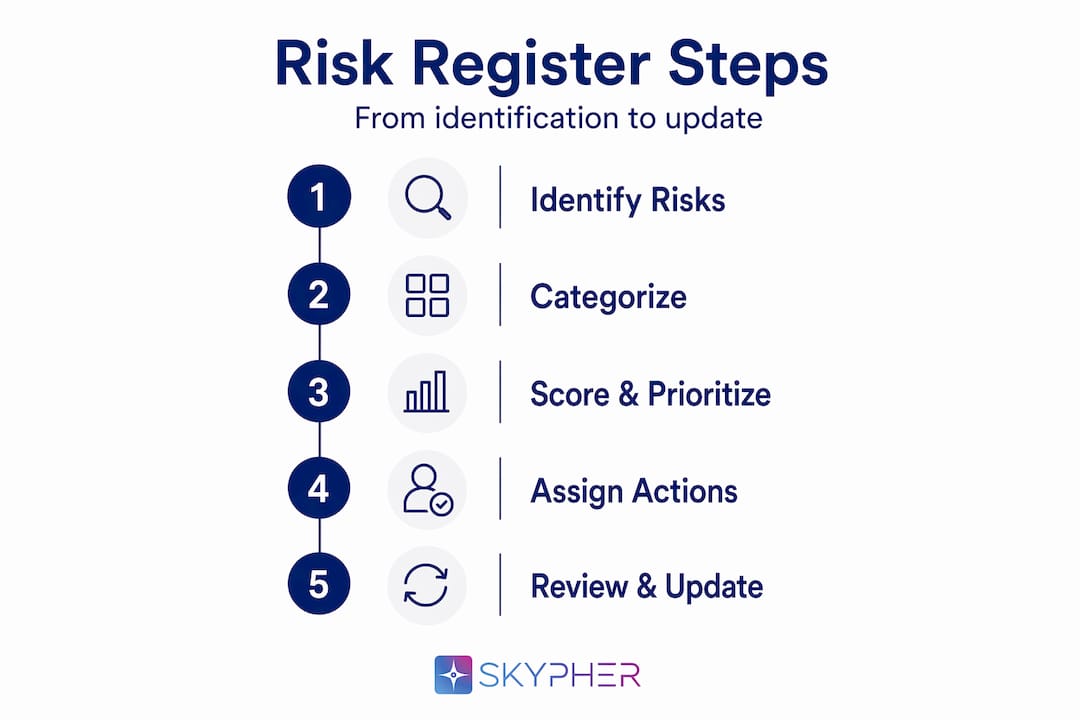
Step three: Assign owners and mitigation plans
Every risk entry needs a named owner, not a team or a department. A named individual is accountable. A team is not. The mitigation plan should be specific enough to guide action: "reduce likelihood by patching the vulnerability by end of sprint 4" beats "monitor and address as needed" every single time.
- Use SMART criteria when writing mitigation actions (specific, measurable, achievable, relevant, time-bound)
- Include a contingency plan alongside the mitigation plan for your highest-scoring risks
- Set review dates for each risk so nothing goes stale by default
Step four: Keep it current
This is where most risk registers fail. Schedule formal register reviews tied to governance checkpoints, not just whenever someone remembers. When a risk changes status or a mitigation action is completed, update the register that same week. Stale data is worse than no data because it creates false confidence.
Pro Tip: Build risk register reviews into your existing governance calendar rather than creating a separate process. Attach a 15-minute register review to your monthly steering committee meeting and compliance becomes habitual.
Using a risk register for decisions and compliance
An actively managed risk register does something a static spreadsheet never can: it changes how your organization behaves before problems materialize. Risk registers enable informed decisions before risks escalate into issues, which is where the real financial and operational value lies.
Consider the compliance dimension specifically. When an auditor asks for evidence that your organization identifies, assesses, and monitors risks, a current risk register is your best answer. It shows a documented process, dated updates, named owners, and evidence of follow-through on mitigation actions. That is audit transparency in practice.
The table below illustrates the difference between passive and active register use:
| Register behavior | Practical outcome |
|---|---|
| Updated monthly, tied to governance | Risks are addressed before they become incidents |
| Updated quarterly or annually | Response is reactive; surprises increase |
| Linked to budget and resource allocation | Mitigation actions receive funding and ownership |
| Maintained separately from decisions | Register becomes documentation for appearances only |
| Shared with executives and auditors | Trust, transparency, and faster audit cycles |
Supplier risk programs make this point clearly. Organizations that update their vendor risk entries continuously, responding to changes in ownership, jurisdiction, or contractual renewal status, make better sourcing decisions than those treating vendor risks as a once-a-year exercise.
"A risk register treated as static or annual documentation fails to drive the risk treatment decisions it was designed to support."
The governance connection is non-negotiable. Linking registers to decision points triggers funding decisions, escalation paths, and control updates that would otherwise never happen. If your risk register lives in isolation from the decisions your organization actually makes, it is decoration.
My honest take on why most risk registers underperform
I have reviewed a lot of risk registers over the years, and the pattern is almost always the same. The document is technically complete and visually impressive. The scoring is there. The owners are named. But when you look at the audit trail, the last meaningful update was eight months ago, and nobody could point to a single decision that the register directly informed.
The problem is not laziness. It is design. Most organizations build a register because a framework or auditor requires one, then treat it as a compliance artifact rather than a management tool. That distinction matters more than almost anything else in this space.
What I have found actually works is tying every significant risk update to a governance trigger. A risk score crosses a threshold, a change request gets flagged, a quarterly review comes around. Those events force a conversation, and that conversation is where the register earns its keep. Without that connection, even the most beautifully formatted risk register template becomes background noise.
The other issue I see constantly is the absence of shared scoring definitions. When one team rates a risk as "high impact" because it could cost $50,000 and another team uses the same label for something that could cost $5 million, your aggregate risk picture is meaningless. Fifteen minutes spent agreeing on a scoring rubric at project kick-off saves hours of confusion later. I have seen this solved with a single half-page addendum to the register that every stakeholder signs off on before the first risk gets logged.
Modern risk automation tools are genuinely changing what is practical here. Automated alerts when scores change, integrations with governance calendars, and AI-assisted risk identification all make the "keep it current" problem much more manageable. The register itself has not changed. The tooling around it has.
— Gaspard
How Skypher supports smarter risk management
If maintaining an accurate, current risk register sounds labor-intensive, that is because manual processes make it that way. The risk management guide for tech and finance pros on the Skypher blog is a good starting point for understanding where automation delivers the most impact.

Skypher's AI-powered platform handles one of the heaviest risk-related workflows in tech and finance: security questionnaires and third-party risk assessments. By automating questionnaire responses and integrating with over 40 TPRM platforms, Skypher keeps your risk data current and consistent without the manual overhead that causes registers to go stale. The platform's AI security questionnaire automation connects directly to tools like ServiceNow, Slack, and Microsoft Teams, so risk tracking fits inside the workflows your team already uses. For organizations serious about compliance transparency, Skypher's Trust Center also gives auditors and stakeholders real-time visibility into your security and risk posture.
FAQ
What is a risk register in project management?
A risk register is a structured document that records all identified project risks alongside their likelihood, impact, owner, and mitigation plan. It helps project teams monitor and respond to risks before they escalate into issues.
What are the main components of a risk register?
The core fields are risk description, category, likelihood rating, impact rating, risk score, assigned owner, mitigation plan, and current status. These components work together to support prioritization and decision-making across the project lifecycle.
How often should a risk register be updated?
A risk register should be reviewed and updated at every major governance checkpoint and whenever a significant change occurs in the project environment. Registers that go without updates quickly lose their relevance and compliance value.
What is the difference between a risk register and a RAID log?
A RAID log covers risks, assumptions, issues, and decisions, while a risk register focuses solely on risks. Using a dedicated risk register keeps accountability clear and makes compliance reporting and audits more straightforward.
How do you prioritize risks in a risk register?
Most teams score risks by multiplying a likelihood rating by an impact rating to produce a Risk Priority Number. A consistent 1 to 5 scale with shared definitions across the team is the most practical approach to ensuring comparable scores.