

A SOC 1 report is a CPA attestation on a service organization's controls relevant to user entities' internal control over financial reporting, commonly shortened to ICFR. It exists so that auditors and finance teams can rely on outside vendors, like payroll processors or loan servicers, without auditing those vendors themselves.
Two audiences use it: user entities (the companies buying the service) and user auditors (the CPAs auditing those companies' financial statements). Every SOC 1 comes in one of two flavors, and the distinction matters more than most vendor questionnaires suggest:
- Type 1 looks at whether controls were designed and implemented properly as of one specific date.
- Type 2 tests whether those controls actually operated effectively across a period, usually six to twelve months.
If you're evaluating a vendor whose services touch your financial statements, ask for the Type 2 report first. It's the version your auditor will trust.
Key Takeaways
A SOC 1 report gives reasonable, sampling-based assurance on controls relevant to financial reporting, and Type 2 evidence should be the default standard for ongoing vendor reliance.
| Point | Details |
|---|---|
| Definition anchors on ICFR | A SOC 1 is a CPA attestation on controls relevant to a user entity's internal control over financial reporting. |
| Type 2 beats Type 1 for reliance | Type 1 checks design at one date; Type 2 tests operating effectiveness over a period and supports actual audit reliance. |
| Opinion type drives next steps | A qualified opinion signals scope limitation or control failure and warrants a remediation follow-up request. |
| CUECs are your responsibility | Complementary user entity controls listed in the report must be implemented on your side, not just acknowledged. |
| Automation speeds evidence reuse | Tools like Skypher map SOC 1 control language directly into questionnaire answers, cutting manual review time. |
Table of Contents
- What Is a SOC 1 Report and Why Does It Exist?
- SOC 1 Type 1 vs Type 2: What Each Examines
- Who Needs a SOC 1 Report and When Does It Come Up?
- What a SOC 1 Report Contains: Key Sections and Evidence
- How Auditors Evaluate Controls and Where Assurance Runs Out
- Practical Checklist: Requesting and Assessing a SOC 1
- Applying SOC 1 Evidence in Automated Vendor Assessments
- How SOC 1 Findings Affect a User Entity's Financial Statements
- Common Control Areas Covered in SOC 1 Reports
- Overview of the SOC 1 Reporting Process
- Common Limitations and Disclaimers in SOC 1 Reports
- Why Type 2 Should Be Your Default Ask
- Speed Up SOC 1 Evidence Mapping With Skypher
- Sources
What Is a SOC 1 Report and Why Does It Exist?
A SOC 1 report gives assurance that controls at a service organization are relevant to a user entity's ICFR, the internal safeguards that keep a company's financial statements accurate. The AICPA's SOC 1 framework was built specifically for this handoff problem: when a company outsources a financially material process, its auditor still needs evidence that the process is controlled, even though the auditor never sets foot in the vendor's office.
Distribution is restricted on purpose. Unlike a marketing brochure or a public certification badge, a SOC 1 is meant for user entities, their auditors, and management, not for open publication on a vendor's website. That restriction exists because the report contains detailed control descriptions and test results that would be meaningless (or misleading) to a general audience.
Service organizations that typically obtain SOC 1 reports include:
- Payroll processors and benefits administrators
- Loan servicers and lending platforms
- Custodians and fund administrators
- IT infrastructure and data center providers supporting financial systems
The AICPA's attestation standards, specifically the SSAE framework, govern how these examinations are performed and reported. Roughly every industry that touches transaction processing, fund custody, or payroll runs into a SOC 1 request at some point, because these are the exact functions that flow directly into a client's balance sheet or income statement.
SOC 1 Type 1 vs Type 2: What Each Examines
The Type 1 versus Type 2 decision is the first fork in the road, and it changes what the report can actually tell you.
- Type 1 evaluates the design and implementation of controls at a single point in time, essentially a snapshot. It answers, "Were these controls set up correctly as of this date?" It's useful for a new vendor relationship or a first-year engagement where a period of history doesn't exist yet.
- Type 2 covers the same control descriptions but adds testing of operating effectiveness over a defined period, according to TechTarget's SOC 1 overview. It answers the harder question: "Did these controls actually work, consistently, month after month?"
Most user auditors will not rely on a Type 1 alone for an ongoing audit relationship. A Type 1 might satisfy an initial due-diligence check before a contract is signed, but once a vendor is embedded in your financial reporting process, you need Type 2 evidence to support your own audit opinion. If a prospective vendor can only offer Type 1, treat it as a starting point, not a final answer, and set an expectation for Type 2 in the next cycle.
Who Needs a SOC 1 Report and When Does It Come Up?
User entities and their auditors are the primary consumers of a SOC 1, but the request usually originates from procurement, vendor risk, or internal audit teams long before external auditors get involved.
The vendors most often asked to produce one share a common trait: their services directly affect a client's transaction processing or financial statement line items.
- Payroll and HR platforms that calculate and remit wages, taxes, and benefits
- Loan servicers managing principal, interest, and escrow calculations
- Custodians and fund administrators holding or reconciling client assets
- IT infrastructure and transaction-processing platforms supporting financial applications
SOC examinations carry no statutory mandate, but they've become a de facto market requirement as enterprise buyers increasingly demand them during due diligence. In practice, a vendor without a current SOC 1 often loses deals to a competitor who has one ready to hand over.
What a SOC 1 Report Contains: Key Sections and Evidence
A SOC 1 follows a fairly consistent anatomy, and knowing where to look saves hours of reading through boilerplate.
- Management's description of the system: the vendor's own narrative of the services, processes, and controls in scope.
- Control objectives: the specific goals each control is meant to achieve (for example, "transactions are accurately recorded").
- Controls: the actual activities the vendor performs to meet those objectives.
- Tests of controls and results (Type 2 only): the auditor's testing procedures and what they found, according to PwC's SOC reporting guidance.
- The auditor's opinion: unmodified (clean), qualified, adverse, or disclaimer of opinion.
The opinion section is where most readers should start, not end. An unmodified opinion means the auditor found the controls fairly presented and, for Type 2, operating effectively. A qualified opinion flags a specific exception, so read the exception paragraph closely rather than skimming past it.
Watch for complementary user entity controls (CUECs), listed controls the vendor assumes your own organization has in place, such as reviewing reports the vendor sends you or restricting who can approve changes. A SOC 1 opinion can be clean and still leave you exposed if you haven't implemented the CUECs your auditor expects you to have.
Pro Tip: Build a simple tracker that maps each CUEC to the internal control owner responsible for it. Auditors ask about this mapping more often than vendors expect, and having it ready before the request saves a scramble.
How Auditors Evaluate Controls and Where Assurance Runs Out
SOC 1 opinions rest on sampling, not exhaustive review. Auditors select representative transactions and control instances rather than checking every single one, which means the report delivers reasonable assurance, not absolute certainty.
That distinction trips up a lot of first-time readers. A clean opinion doesn't mean zero control failures ever occurred; it means the auditor's testing found nothing that would change their overall conclusion. Practitioners increasingly frame SOC 1 as a tool that quantifies risk rather than eliminates it, since its primary value is independent verification that supports, but doesn't replace, your own risk judgment.
A SOC 1 also isn't a security certification. It speaks specifically to controls relevant to financial reporting, not to general cybersecurity posture, data privacy, or operational resilience. Confusing the two is one of the most common mistakes vendor-risk teams make when reading their first report.
Scope matters just as much as sampling. A narrow scope that excludes a subservice organization your vendor relies on can leave a real gap in your assurance picture, even when the opinion itself reads clean.
Practical Checklist: Requesting and Assessing a SOC 1
Before you file a SOC 1 away as "received," run it through a short review. This is where most of the actual risk decision gets made.
- Confirm the report type (Type 1 or Type 2) and whether it matches what your audit actually needs.
- Check the reporting period for Type 2 reports. Gaps of more than a few months since period-end should raise questions.
- Verify the auditor firm's independence and standing; an unfamiliar or unlicensed firm is a legitimate red flag.
- Review the control objectives and test results for relevance to your own financial processes.
- Read the opinion type carefully. A qualified opinion typically points to a scope limitation or a failed control, and PwC's guidance recommends following up with remediation timelines and re-performance evidence.
- Check how subservice organizations are handled: carved out or included?
- Cross-reference the CUECs against your own control environment.
Watch for restricted access with no clear explanation, recurring qualifications year over year, or scope that quietly narrowed since the last report. According to TechTarget, tracing each control objective back to your own relevant financial statement assertion is the step that turns a vendor's report into something you can actually rely on.
Applying SOC 1 Evidence in Automated Vendor Assessments
Compliance teams increasingly lift control statements straight out of a SOC 1 and drop them into security questionnaires and RFP responses, saving hours of manual rewriting. Automation now handles much of that mapping work.
- Match control language in a SOC 1 to the exact wording a questionnaire asks for
- Pull tested control results into evidence libraries for reuse across multiple vendor reviews
- Flag gaps where a questionnaire question has no corresponding SOC 1 control to cite
Teams using platforms that map control statements automatically report faster turnaround on vendor assessments than manual copy-paste review allows. For a closer look at how Type 2 evidence specifically feeds compliance workflows, see this breakdown of SOC 1 Type 2 reports.
How SOC 1 Findings Affect a User Entity's Financial Statements
A SOC 1 finding doesn't sit in an isolated compliance folder. It flows directly into how your own auditor evaluates your financial statements, because the vendor's controls are effectively an extension of your own internal control environment.
When a SOC 1 carries an unmodified opinion, your auditor can generally reduce the amount of independent testing they'd otherwise perform on transactions processed by that vendor. That translates into a smoother, often shorter audit cycle for your organization.
A qualified opinion works the opposite way. If a payroll processor's SOC 1 flags a control exception around wage calculation accuracy, your auditor may need to perform additional substantive testing on payroll expense, request compensating evidence from your own team, or, in more serious cases, factor the exception into their overall risk assessment of your financial statements. The exception doesn't automatically mean your numbers are wrong. It means the auditor can't lean on the vendor's controls alone to conclude they're right.
This is why CUECs matter so much in practice. Even a clean SOC 1 opinion assumes you've implemented the complementary controls listed in the report. Skip that step, and your auditor may still need to test around the gap, regardless of how clean the vendor's own opinion reads. The net effect: a SOC 1's findings shape audit scope, timeline, and cost for the user entity, not just the vendor's own compliance posture.
Common Control Areas Covered in SOC 1 Reports
SOC 1 control objectives cluster around a handful of recurring themes, because the underlying risk to financial reporting tends to look similar across service organizations regardless of industry.
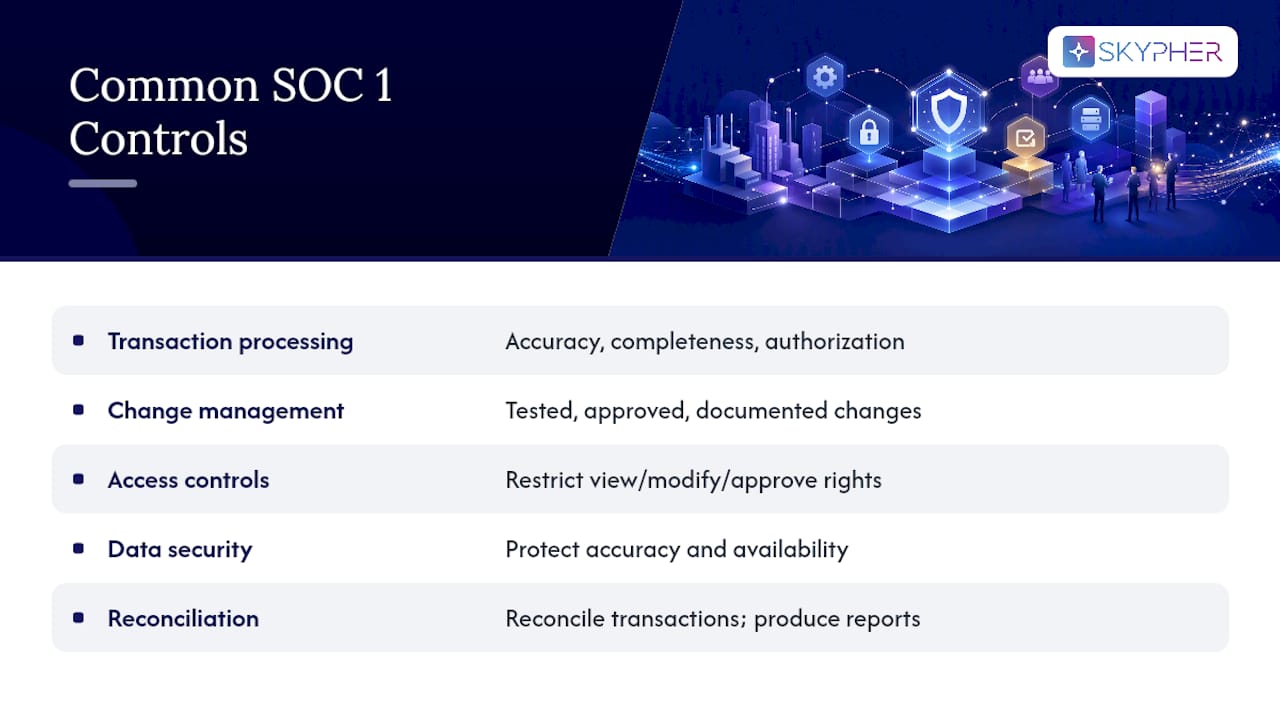
Transaction processing shows up in nearly every SOC 1, whether the vendor is a payroll processor calculating withholdings or a loan servicer applying payments to principal and interest. Controls here typically address accuracy, completeness, and authorization: are transactions recorded correctly, are they all captured, and did the right person approve them?
Change management controls cover how the vendor modifies the systems that process your financial data, requiring testing, approval, and documentation before changes go live. A poorly controlled change process can silently break a calculation that's been working correctly for years.
Access controls determine who can view, modify, or approve financial data within the vendor's systems. This overlaps with data security, but the SOC 1 lens is narrower than a general security review. It asks specifically whether access restrictions protect the integrity of financial reporting, not whether the vendor has broad cybersecurity coverage.
Data security related to financial reporting appears as a control area when it directly affects the accuracy or availability of financial data, such as encryption of stored transaction records or backup procedures that prevent data loss during processing failures.
Reconciliation and reporting controls round out the common list, covering how a vendor reconciles processed transactions against source records and how it generates the reports user entities rely on for their own close process.
Overview of the SOC 1 Reporting Process
Getting from "we need a SOC 1" to a finished report takes several months and involves more coordination than most first-time service organizations expect.
The process starts with readiness assessment, where the vendor (often with outside help) maps its existing controls against the objectives it intends to include in scope. This stage frequently surfaces gaps that need remediation before an auditor ever gets involved.
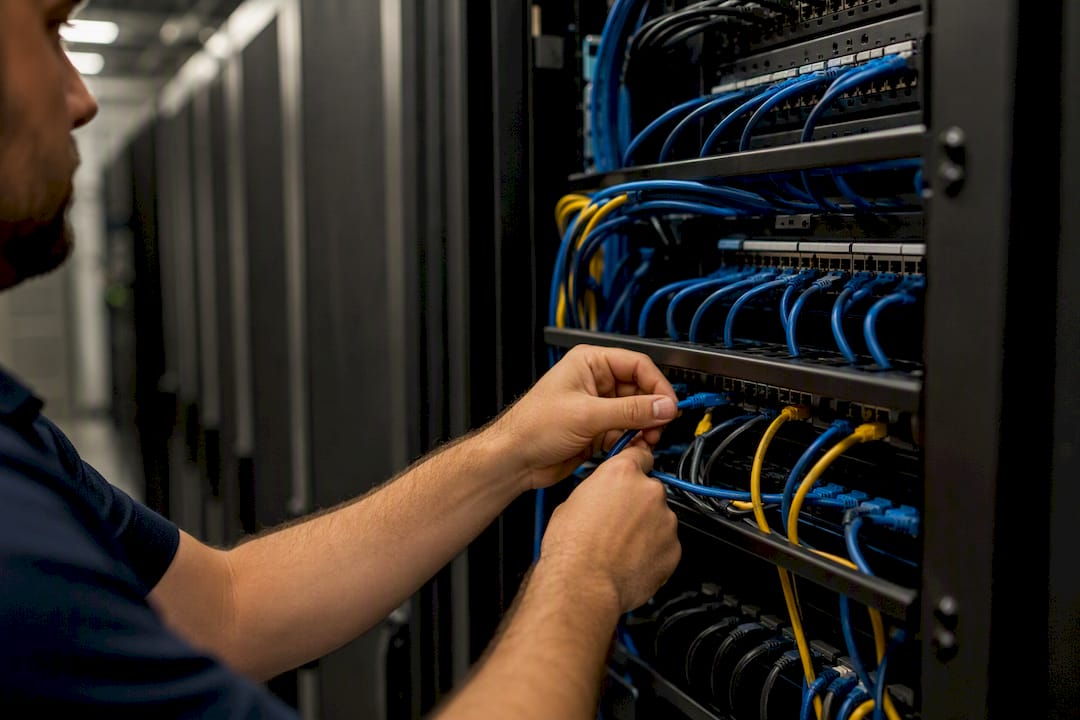
Next comes scoping and planning, where the vendor and its chosen CPA firm agree on which systems, processes, and control objectives fall inside the examination boundary, and which subservice organizations get carved out versus included.
For a Type 1 engagement, the auditor then tests design and implementation as of a single date and issues the report shortly after fieldwork wraps.
For a Type 2 engagement, the vendor must operate the described controls consistently across the full reporting period, typically six to twelve months, before the auditor can test operating effectiveness. This is why a first-year Type 2 report often doesn't exist. Organizations frequently start with a Type 1 to establish the baseline, then move to Type 2 once they've operated the controls long enough to generate a testing period.
Throughout the period, the auditor performs interim and final testing, documents exceptions, and drafts the management description alongside the vendor. The engagement closes with the auditor's opinion and final report issuance, after which the vendor distributes it under restricted-use terms to qualifying user entities and their auditors.
Common Limitations and Disclaimers in SOC 1 Reports
Every SOC 1 carries built-in limitations that shape how much weight you can reasonably put on it, and missing these is one of the more expensive mistakes a vendor-risk team can make.
The report provides reasonable assurance, not a guarantee. Auditors sample transactions and control instances rather than examining every single one, so a clean opinion reflects what testing found, not a certification that no control ever failed during the period.
Scope is another limitation hiding in plain sight. A SOC 1 only covers the systems and control objectives the vendor and auditor agreed to include. If a subservice organization handling part of the process is carved out of scope, you're left with a gap that the report itself won't flag loudly, you have to notice it.
The restricted-use disclaimer matters too. SOC 1 reports are explicitly not intended for general distribution or for parties without sufficient knowledge of the service organization's system, which is why vendors typically require an NDA before sharing one.
Finally, a SOC 1 says nothing about general cybersecurity, availability, or privacy practices. That's the scope of a SOC 2 examination, a related but distinct report built around the Trust Services Criteria rather than ICFR. Confusing the two disclaimers is a recurring source of misplaced confidence during vendor reviews.
Why Type 2 Should Be Your Default Ask
Most compliance teams accept whatever report a vendor hands over. That's backwards. If the vendor's work touches your financial statements, insist on Type 2 evidence before you build a reliance decision around it. A Type 1 tells you controls exist; a Type 2 tells you they held up.
SOC 1 evidence works best alongside other signals, not in isolation. Pair it with penetration test summaries, contractual SLAs, and your own CUEC review before signing off on a vendor relationship.
— Gaspard
Speed Up SOC 1 Evidence Mapping With Skypher
Reading a SOC 1 is one job. Turning its control language into answers for a 200-question security review is a different, more tedious job, and it's the one that eats up compliance team hours every quarter. Skypher's AI-driven Questionnaire Automation Tool pulls control statements and tested results straight from a SOC 1 and matches them to the exact wording a questionnaire or RFP asks for, cutting the manual copy-paste work that usually slows down vendor reviews.

For enterprise teams juggling multiple products, entities, or subservice organizations, that mapping problem multiplies fast. Skypher's platform handles complex setups, integrates with over 40 third-party risk management tools like OneTrust and ServiceNow, and supports real-time collaboration so audit, sales, and compliance teams aren't passing the same document back and forth by email. If your team spends more time formatting SOC 1 excerpts than actually reviewing them, visit Skypher's site to see a demo of the questionnaire automation workflow in action.
Sources
- SOC 1® - SOC for Service Organizations: ICFR
- System and Organization Controls (SOC) Reporting - PwC
- What is SOC 1 (System and Organization Controls 1)? - TechTarget
- What is a SOC Report? - Baker Tilly