

TL;DR:
- Vendor security assessments are often slow and unreliable, relying on vague assurances that lack accountability when incidents occur. The CAIQ questionnaire standardizes self-assessments, enabling compliance teams to evaluate cloud providers with documented, evidence-backed responses, and is mandatory for STAR Registry submissions by December 2027. Proper preparation, including understanding the latest version, gathering relevant documentation, and aligning responses with the Cloud Controls Matrix, enhances accuracy, reduces delays, and builds trust through transparency and honest reporting.
Vendor security assessments are slow, inconsistent, and often rely on vague assurances that mean nothing when an incident occurs. The CAIQ questionnaire changes that equation entirely. Developed by the Cloud Security Alliance, this standardized self-assessment tool gives compliance professionals a structured way to evaluate cloud service providers against a defined set of controls, replacing guesswork with documented, evidence-backed responses. This guide walks you through exactly how to prepare, complete, troubleshoot, and act on a CAIQ assessment in 2026, whether you are evaluating a new vendor or managing your own submission for a customer.
Table of Contents
- Key takeaways
- What you need before starting the CAIQ questionnaire
- How to complete the CAIQ questionnaire accurately
- Common pitfalls when working with CAIQ assessments
- Verifying and using your CAIQ results
- My honest take on CAIQ after years in the field
- How Skypher makes CAIQ completion faster and more accurate
- FAQ
Key takeaways
| Point | Details |
|---|---|
| Know your version | CAIQ v4.1 is the current standard with 283 questions; all STAR Registry submissions must use it by December 2027. |
| Gather evidence before starting | Collect internal policies, audit reports, and certifications before answering a single question. |
| Avoid yes bias | Unsupported "yes" answers create liability. Accurate responses with explanations build more trust than inflated ones. |
| N/A answers need context | Cloud-specific controls marked N/A require detailed written explanations to reduce audit friction. |
| CAIQ is not a certification | It is a self-assessment framework that supplements, but does not replace, formal audits or certifications. |
What you need before starting the CAIQ questionnaire
Getting your CAIQ questionnaire right starts well before you open the spreadsheet. Rushing into responses without the proper groundwork is one of the most common reasons submissions end up inconsistent, inaccurate, or rejected during vendor review.
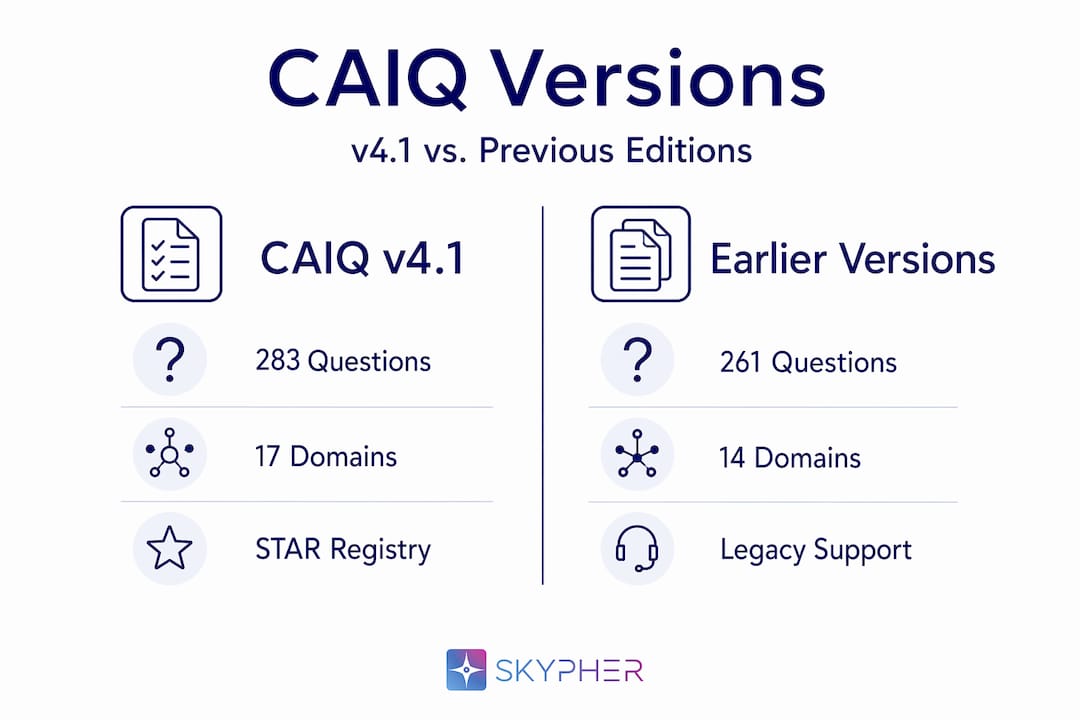
Understand which version applies to you. The current CAIQ standard is v4.1, which contains 283 questions spread across 17 security domains. This is a meaningful upgrade from v4.0, which carried 261 questions. CAIQ v4.1 also introduces support for machine-readable formats including JSON, YAML, and OSCAL, which matters if you plan to integrate results with automated workflows. If you are submitting to the CSA STAR Registry, both older versions and v4.1 are currently accepted, but STAR Registry submissions must fully transition to v4.1 by December 2027.
Decide between full CAIQ and CAIQ-Lite. Not every organization needs to answer all 283 questions. The CAIQ-Lite version is designed for smaller organizations or assessments with limited scope, offering a focused set of questions that still provide meaningful security visibility. If you are a SaaS vendor serving enterprise customers, however, expect the full CAIQ assessment to be required. Know your context before committing to either format.
Gather your documentation first. Nothing slows down a CAIQ survey more than hunting for policies mid-response. Before you begin, pull together:
- Your information security policy and any domain-specific sub-policies
- Current certifications such as SOC 2, ISO 27001, or FedRAMP
- Recent penetration test summaries and vulnerability scan results
- Business continuity and disaster recovery plans
- Evidence of access control procedures and privileged access reviews
- Data classification and encryption standards
Understand the Cloud Controls Matrix (CCM). The CAIQ assessment maps directly to the CCM, which defines the controls being measured. Treat CCM as the control framework and CAIQ as the mechanism to self-report against it. Conflating the two is a mistake many teams make, and it leads to misaligned responses.
Pro Tip: Build a master evidence repository indexed by CCM control ID before you start. When you reach a question, the supporting document is already tagged and ready. This cuts completion time significantly and makes future updates far less painful.
| Preparation task | Why it matters |
|---|---|
| Identify CAIQ version | Ensures compatibility with STAR Registry requirements |
| Choose full CAIQ or CAIQ-Lite | Matches assessment scope to organizational complexity |
| Compile security documentation | Provides the evidence base for accurate responses |
| Familiarize yourself with CCM domains | Aligns your answers to the correct control objectives |
How to complete the CAIQ questionnaire accurately
With your documents organized and your version selected, you can move into the actual work of completing the CAIQ form. This is where most compliance teams either build credibility or quietly undermine it.
-
Work domain by domain, not question by question. CAIQ v4.1 is organized across 17 security domains including Identity and Access Management, Data Security, Incident Management, and Supply Chain. Assign domain ownership to subject matter experts rather than having one person answer everything. A network engineer should own the Infrastructure and Virtualization section. Your privacy counsel should weigh in on Data Security. This distribution improves accuracy and reduces the bottleneck of a single reviewer.
-
Interpret response options correctly. Most CAIQ questions follow a yes/no/not applicable format. "Yes" should mean the control is fully implemented with evidence to back it up. "No" should never be left bare without context. "Not applicable" is valid but requires a written explanation of why the control does not apply to your environment. Detailed explanations for N/A responses reduce audit friction and demonstrate that you have actually considered the control rather than dismissed it.
-
Add a written response for every answer, even "yes." Most templates include a free-text field alongside the yes/no selection. Use it. Reference the policy or procedure that supports the answer. Cite your certification where applicable. A response that says "Yes — covered under our ISO 27001 certification, control A.9.4" is far more credible than a bare checkbox.
-
Confront partial implementation honestly. If a control is partly in place, say so. Describe what exists and what is planned. Auditors and procurement teams respect transparency. A partially implemented control with a documented remediation timeline reads as mature security practice. A false "yes" reads as a liability the moment evidence is requested.
-
Resist yes bias. This is the single most damaging pattern in CAIQ completion. The pressure to appear fully compliant leads organizations to check "yes" on controls they have only partially addressed, or have informally handled without documentation. When the customer follows up for evidence, the conversation becomes damaging. The CAIQ assessment is a self-assessment, and the CAIQ framework is designed to replace vague security promises with honest, structured responses.
-
Use automation where it genuinely helps. AI-assisted tools can match existing policies to relevant CAIQ questions, flag inconsistencies across responses, and surface previously submitted answers for reuse. This is particularly valuable when completing multiple concurrent questionnaires or when updating a prior submission. Learn more about how AI questionnaire automation is changing how compliance teams work through these at scale.
Pro Tip: Run a consistency check before submitting. If you answered "yes" to having a formal access review process, your responses in Identity and Access Management and in Compliance should align. Contradictions across domains are a red flag reviewers catch immediately.
Common pitfalls when working with CAIQ assessments
Even experienced compliance teams hit the same avoidable walls. Knowing where things tend to go wrong is half the battle.

The most damaging mistake is treating your CAIQ survey as a one-time exercise. Security posture changes. A control you fully implemented last year may have degraded due to staff turnover, a platform migration, or a process gap. Many organizations complete a CAIQ form, publish it to the STAR Registry, and never revisit it until a customer asks why the submission is three years old. Schedule a formal annual review and update the document whenever a significant change occurs.
A close second is the CCM confusion problem. CCM defines what controls are expected; CAIQ measures whether those controls exist. Answering CAIQ questions without understanding the underlying CCM control objective leads to surface-level responses that do not hold up under scrutiny. Before answering any question, read the associated CCM control description. This context changes the quality of your answer.
Organizations that provide clear, documented N/A explanations demonstrate a higher level of control awareness than those that simply leave answers blank or mark them without context. Transparency in the CAIQ form builds more trust than a perfect score with no supporting evidence.
Version management is another area where teams struggle. With CAIQ v4.1 expanding the question set from 261 to 283 questions, organizations moving from v4.0 need to account for the new controls rather than copy-paste their prior responses. Map the delta carefully and treat new questions with fresh review.
If you are a CSP fielding multiple customer-submitted questionnaires simultaneously, create a master CAIQ response library. This central repository of pre-approved, reviewed answers allows your team to respond faster without starting from scratch each time, and it keeps messaging consistent across customers.
Verifying and using your CAIQ results
A completed CAIQ assessment has real strategic value beyond checking a procurement box. How you use it determines whether it actually improves your security posture and vendor relationships.
Review for internal consistency before sharing. A completed CAIQ form should be internally consistent. If your encryption policy is referenced in the Data Security domain, the same policy should be cited anywhere encryption appears in other domains. Inconsistencies signal either siloed responses or sloppy coordination. Run a cross-domain review before submission.
Supplement with formal certifications. CAIQ responses are self-reported and do not carry the weight of an independent audit. Customers who need higher assurance will ask for your SOC 2 report, ISO 27001 certificate, or a penetration test summary alongside your CAIQ form. Having these ready and referenced within your CAIQ responses adds significant credibility.
Integrate with your GRC tooling and vendor risk dashboards. CAIQ results exported in JSON, YAML, or OSCAL formats can be ingested directly into GRC platforms and third-party risk management tools. This creates a live, queryable record of vendor security posture rather than a PDF sitting in someone's inbox. If you are evaluating vendors, this integration gives you a way to compare assessments systematically.
Pro Tip: When reviewing a vendor-submitted CAIQ survey, pay close attention to how they handle "no" and "not applicable" responses, not the "yes" answers. The quality of explanation in those answers tells you far more about their security maturity than any score.
| Use case | How to apply CAIQ results |
|---|---|
| Vendor onboarding | Compare responses against your minimum control thresholds before contract |
| Ongoing vendor management | Track CAIQ submission dates and schedule annual re-assessments |
| CSA STAR Registry | Submit completed v4.1 CAIQ to demonstrate public cloud security transparency |
| GRC integration | Import JSON or OSCAL exports into your risk platform for automated tracking |
For procurement and ongoing vendor management, CAIQ assessment data should feed directly into your vendor risk tiering. A vendor who scores well across the 17 domains but lacks certifications may be appropriate for lower-risk use cases. A vendor with strong certifications and a well-documented CAIQ form earns access to more sensitive workloads. That distinction should be explicit in your vendor management policy, not a judgment call made case by case. Understanding how self-assessment workflows can be structured for security teams makes this ongoing management far more manageable.
My honest take on CAIQ after years in the field
I have seen organizations spend enormous energy on their CAIQ submissions, treating them like a certification they are trying to pass. That framing is wrong, and it produces bad results. The CAIQ questionnaire is a self-assessment tool. Its value is in the honesty of the process, not the appearance of the output.
What I have learned from working with complex multi-entity organizations is that the most credible CAIQ submissions are the ones that show genuine reflection. They acknowledge gaps, explain compensating controls, and reference evidence throughout. The submissions that raise red flags are the ones where every answer is "yes" with no supporting context. That pattern tells a reviewer that either the organization did not really examine the questions, or they are not being honest.
On automation: the technology available today for completing a cloud assurance questionnaire has improved dramatically. AI can surface relevant past answers, flag inconsistencies, and cut completion time from days to hours. But automation does not fix the underlying problem of a security program that has not matured. The tool can help you respond. It cannot manufacture controls you have not built. Use AI to handle the compliance process at scale, but invest the time saved into actually improving your controls.
My prediction for the near future: as CAIQ v4.1 adoption increases and more organizations integrate machine-readable formats into their GRC workflows, the questionnaire will shift from a static document exchange to a near-real-time data feed. The compliance teams that invest now in structured, well-documented CAIQ responses will be far ahead when that shift happens.
— Gaspard
How Skypher makes CAIQ completion faster and more accurate

If your team is spending days on every CAIQ questionnaire, that is a workflow problem with a direct solution. Skypher's security questionnaire automation platform uses AI to match incoming questions to your existing policy library, draft accurate responses in seconds, and flag answers that need human review. It supports all major formats including the JSON and OSCAL exports used in CAIQ v4.1, and connects to over 40 TPRM platforms so your completed assessments flow directly into your risk management tools. With the AI-powered recommendation engine, response quality improves over time as the system learns your organization's controls and preferred response style. For teams managing multiple vendors and repeated CSP security evaluations, Skypher turns what used to be a multi-day project into something your team can handle in under an hour.
FAQ
What is the CAIQ questionnaire?
The CAIQ questionnaire is a standardized self-assessment tool developed by the Cloud Security Alliance that helps cloud service providers document their security controls across 17 domains. It allows enterprise buyers to evaluate vendor security posture consistently and transparently.
How many questions are in CAIQ v4.1?
CAIQ v4.1 contains 283 questions across 17 security domains, an increase from 261 questions in the previous version. It also supports machine-readable formats like JSON, YAML, and OSCAL for automated processing.
What is the difference between CAIQ and CAIQ-Lite?
CAIQ-Lite is a simplified version of the full questionnaire designed for smaller organizations or lower-complexity assessments. The full CAIQ assessment is more appropriate for enterprise cloud service providers being evaluated by large customers with detailed security requirements.
Is a completed CAIQ form the same as a security certification?
No. A CAIQ assessment is a self-reported document without independent verification. It can be supplemented by certifications like SOC 2 or ISO 27001, but it does not carry the same weight as a formal third-party audit.
When must organizations transition to CAIQ v4.1?
Organizations submitting to the CSA STAR Registry must complete their transition to CAIQ v4.1 by December 2027. Both older versions and v4.1 are accepted during the transition period.