

TL;DR:
- A SIG questionnaire gathers detailed security and control information from vendors across multiple risk domains. It helps compliance officers evaluate vendor security posture but should be used as part of a broader risk management program. Continuous monitoring and independent validation are essential for accurate vendor risk assessments.
A SIG questionnaire is an industry-standard vendor due diligence tool that collects detailed information about third-party security controls across multiple risk domains. The acronym stands for Standardized Information Gathering, and it gives compliance officers a structured way to evaluate any vendor's security posture before or during a business relationship. If your organization operates in finance, healthcare, or any regulated sector, understanding the SIG questionnaire definition is not optional. It is the baseline language of vendor risk management.
The SIG is updated annually each january to stay aligned with evolving cybersecurity standards. The 2026 version maps responses to major frameworks including NIST CSF, ISO 27001, SOC 2, PCI DSS, HIPAA, and GDPR. That cross-framework alignment means a vendor can satisfy multiple buyer compliance needs with a single set of responses. Financial services and healthcare organizations request SIG assessments most frequently due to their stringent regulatory obligations.

What is a SIG questionnaire and what does it cover?
A SIG questionnaire covers 18–19 risk domains spanning cybersecurity, privacy, operational resilience, and financial considerations. That breadth is what separates it from narrower, topic-specific security surveys. A single completed SIG gives a buyer a structured view of a vendor's entire control environment, not just one slice of it.
The specific domains include access controls, application security, data management, business continuity, physical security, network security, privacy, incident response, and regulatory compliance. Each domain contains targeted questions designed to surface gaps in a vendor's security program. The goal is a complete picture, not a spot check.
SIG Full vs. SIG Lite: choosing the right depth
The SIG comes in two versions, and choosing the wrong one wastes everyone's time. SIG Full contains over 800 questions and dives into control implementation details and evidence. SIG Lite is a streamlined version with roughly 200 questions, focused on whether controls exist rather than how they are implemented.
| Feature | SIG Lite | SIG Full |
|---|---|---|
| Question volume | ~200 questions | 800+ questions |
| Focus | Control existence | Control implementation and evidence |
| Best use case | Initial screening, lower-risk vendors | High-risk vendors, sensitive data handlers |
| Completion time | Shorter | Significantly longer |
| Framework mapping | Yes | Yes, with greater detail |
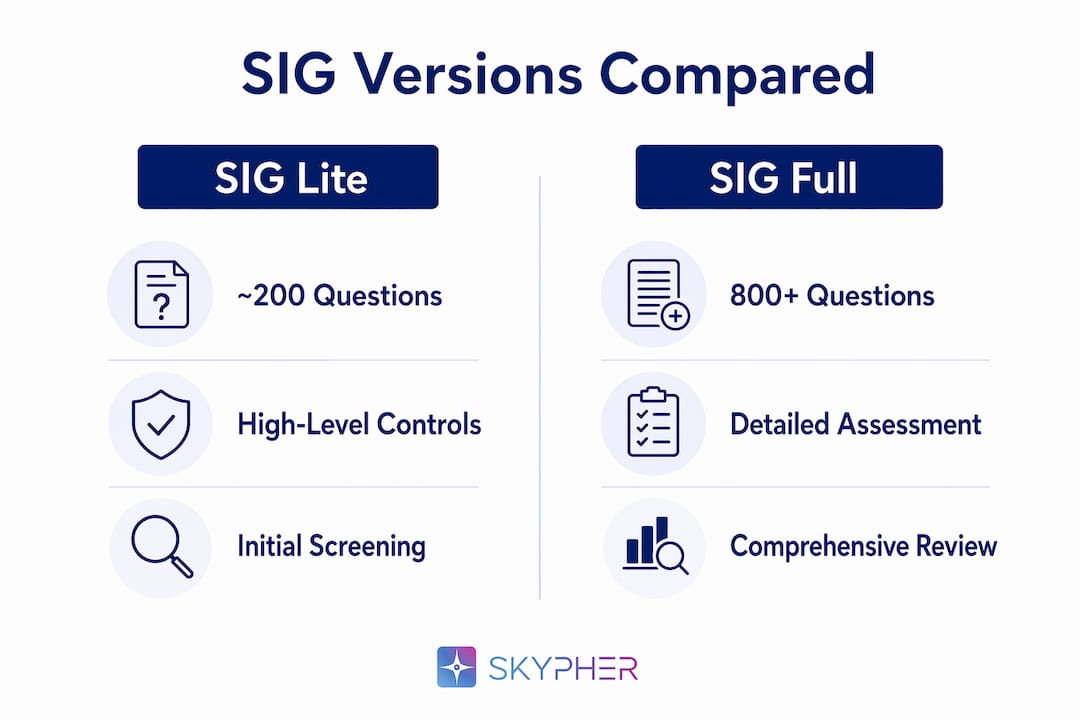
SIG Lite covers the same domains as SIG Full but at a higher level. This makes it the right tool for initial vendor tiering, not for deep-dive assessments of vendors handling critical infrastructure or sensitive personal data.
Pro Tip: Always confirm with your client or procurement team which version they require before you start gathering documentation. Completing SIG Full when SIG Lite was requested wastes weeks of internal effort.
How do compliance officers use SIG questionnaires in vendor risk programs?
The SIG questionnaire plays a specific role in a broader third-party risk management workflow. It is not a one-time checkbox. Compliance officers use it at multiple stages: initial vendor onboarding, periodic reassessment, and when a vendor's risk profile changes due to a new contract scope or a reported incident.
The most effective approach follows a tiered model:
- Screen all new vendors with SIG Lite. This initial pass identifies obvious gaps and separates low-risk vendors from those requiring deeper review.
- Escalate high-risk vendors to SIG Full. Vendors handling sensitive data, critical systems, or large transaction volumes need the full assessment. Tiering vendors this way saves resources and focuses detailed scrutiny where it matters most.
- Map SIG responses to your internal control framework. Because SIG cross-maps to NIST CSF, ISO 27001, and other standards, you can align vendor responses directly to your own compliance requirements without running separate questionnaires.
- Document and store responses centrally. SIG responses serve as audit evidence. A centralized repository makes it easy to retrieve documentation during regulatory reviews or client audits.
- Reassess on a defined schedule. Annual reassessment is standard practice for high-risk vendors. Lower-risk vendors may follow an 18-month or 24-month cycle depending on your risk appetite.
The SIG's cross-framework mapping also reduces the burden on vendors. Instead of answering five different questionnaires from five different buyers, a vendor can complete one SIG and use those responses across multiple client requests. That efficiency is one reason the SIG has become the default format in regulated industries.
What does a SIG questionnaire measure vs. a full risk assessment?
This distinction matters more than most compliance teams realize. A SIG questionnaire is a data-gathering tool. It collects self-reported information about a vendor's controls. It does not score, rank, or validate those controls independently.
A full vendor risk assessment goes further. It incorporates financial health monitoring, operational resilience signals, contractual controls, and sometimes on-site audits or third-party attestations like SOC 2 reports. The SIG provides the raw material. The risk assessment is what you build with it.
Treating SIG responses as a complete risk verdict is the most common and costly mistake in vendor risk programs. A vendor can answer every SIG question correctly and still represent significant operational or financial risk. Continuous monitoring, contractual obligations, and independent audit evidence fill the gaps that self-reported questionnaire data cannot.
Pro Tip: Pair every completed SIG Full with at least one independent control validation, such as a SOC 2 Type II report, a penetration test summary, or an ISO 27001 certificate. Self-reported answers are a starting point, not a conclusion.
The SIG also does not assess a vendor's financial stability, geographic concentration risk, or supply chain dependencies. Those factors require separate data sources. Compliance officers who understand what the SIG measures and what it does not are far better positioned to build programs that actually reduce risk rather than just document it.
How to prepare for and respond to a SIG questionnaire
Preparation is where most organizations lose time. A disorganized response process leads to inconsistent answers, missed deadlines, and follow-up requests that drag on for weeks. The fix is a structured approach before the first question is answered.
- Assign domain owners before you start. Each of the 18–19 SIG risk domains requires input from a specific internal team. Access controls belong to IT. Privacy questions go to legal or data protection. Business continuity answers come from operations. Trying to route everything through one person creates bottlenecks.
- Build a centralized evidence repository. Common mistakes include not having documentation ready and failing to coordinate subject matter experts. A shared folder or knowledge base with current policies, certificates, and audit reports cuts response time dramatically.
- Clarify requirements with the requesting party first. Ask whether they need SIG Lite or SIG Full, which version year they are using, and whether they have any custom addenda. Starting with the wrong version or the wrong year wastes significant effort.
- Review previous responses before starting fresh. If your organization has completed a SIG before, last year's responses are your best starting point. Update what has changed rather than rebuilding from scratch.
- Validate answers before submission. Have each domain owner review their section for accuracy and completeness. Inconsistent or vague answers generate follow-up questions that extend the review cycle.
Maintaining a living evidence repository is the single highest-leverage investment a compliance team can make. It cuts the time to complete a new SIG from weeks to days, and it ensures that answers are consistent across multiple client requests.
Key Takeaways
A SIG questionnaire is the standard tool for gathering vendor security data, but its value depends entirely on how it is used within a broader risk program.
| Point | Details |
|---|---|
| SIG covers 18–19 risk domains | Domains span cybersecurity, privacy, operational resilience, and financial considerations. |
| Two versions serve different needs | Use SIG Lite for initial screening and SIG Full for high-risk vendors handling sensitive data. |
| SIG is not a risk assessment | Supplement SIG responses with financial monitoring, audits, and contractual controls. |
| Cross-framework mapping saves time | SIG maps to NIST CSF, ISO 27001, SOC 2, PCI DSS, HIPAA, and GDPR in a single response. |
| Centralized evidence cuts response time | A shared repository of policies and certificates reduces completion time from weeks to days. |
The SIG is only as good as the program around it
I have worked with compliance teams that treat a completed SIG as a finished risk assessment. They file it, check the box, and move on. That approach gives a false sense of security that is genuinely dangerous.
The SIG is a structured conversation starter. It tells you what a vendor claims about their controls. What it cannot tell you is whether those controls actually work, whether the vendor's financial position is stable enough to honor their commitments, or whether a key subprocessor in their supply chain just had a breach. I have seen organizations with perfect SIG scores fail on all three of those dimensions within the same quarter.
The teams that get the most value from SIG questionnaires treat them as one input in a continuous monitoring program. They use SIG Lite to triage, SIG Full to investigate, and independent attestations to validate. They also automate wherever possible. Manually managing hundreds of SIG responses across a large vendor portfolio is not sustainable. The organizations moving to AI-assisted response workflows are completing assessments in a fraction of the time, with fewer errors and more consistent answers across requests.
My advice to compliance officers in 2026: stop defending the SIG as a complete solution and start building the infrastructure around it. The questionnaire is the floor, not the ceiling.
— Gaspard
How Skypher helps teams manage SIG questionnaire workflows
Security questionnaire fatigue is real. Compliance teams that handle dozens of SIG requests per quarter need more than a shared spreadsheet.

Skypher's AI-powered questionnaire automation tool handles SIG responses across every format, connects to over 40 third-party risk management platforms, and can process 200 questions in under a minute. The platform integrates with Slack, Microsoft Teams, Confluence, Google Drive, and SharePoint, so your subject matter experts can contribute answers without leaving their existing workflows. Skypher's Trust Center lets your organization share a current, verified compliance posture with clients on demand, reducing the back-and-forth that slows every vendor review cycle.
FAQ
What does SIG stand for in a security questionnaire?
SIG stands for Standardized Information Gathering. It is a vendor due diligence questionnaire developed to collect structured security and risk information from third-party vendors.
What is the difference between SIG Lite and SIG Full?
SIG Lite contains roughly 200 questions and focuses on whether controls exist, making it suitable for initial vendor screening. SIG Full contains over 800 questions and examines how controls are implemented, designed for high-risk vendors handling sensitive data.
How often is the SIG questionnaire updated?
The SIG is updated annually each january. The 2026 version maps to NIST CSF, ISO 27001, SOC 2, PCI DSS, HIPAA, and GDPR.
Is a completed SIG questionnaire the same as a vendor risk assessment?
No. A SIG questionnaire gathers self-reported data about a vendor's controls. A full vendor risk assessment also incorporates financial monitoring, independent audits, and contractual controls to validate and contextualize that data.
Who typically requests a SIG questionnaire?
Financial services and healthcare organizations request SIG assessments most frequently due to their regulatory requirements. Any organization with a formal third-party risk management program may use SIG as part of vendor onboarding or periodic reassessment.